Across generations, indulgence in luxury has been a deep sense of pride for many individuals, with the desire for it only intensifying over time. Oftentimes, luxury has been the perfect language to translate one’s identity, values, and social position, but, most importantly, the richness and fulfillment of one’s existence. This very essence of luxury begins with nature’s unparalleled contribution to its creation.
Luxury’s Silent Source
To this day, the luxury industry remains heavily reliant on nature and its resources in the development of its creations. Nature contributes to the quality, craftsmanship, and distinctiveness associated with luxury, shaping the standards of excellence expected across the industry. Centered on intentionality and exclusivity, luxury’s dedication to crafting excellence begins with nature’s resources. From creative conception and design to exceptional craftsmanship, continuous innovation, and premium experiences, luxury is supported by nature’s endowments at every level.
Whether directly or indirectly, most tangible luxury products depend on nature’s finest resources. Each industry in the luxury market relies on its own combination of resources, such as flowers for fragrances, cotton and leather for fashion, grapes for wine, and precious metals and gemstones for jewelry and watches. This dependence has, over time, placed considerable strain on the environment and the sources that have sustained it. Although the integration of alternative materials has gradually reduced reliance on certain resources over the past decade, the luxury industry has no intention of operating independently of nature, which has long been central to its creations beyond raw materials.
In recent years, the escalation of production and consumption has increased the strain on nature’s resources. Despite lower production volumes than the mass and premium markets, the luxury industry’s reliance on resource-intensive materials such as leather, precious metals, gemstones, fine textiles, and natural ingredients has significant environmental implications. The extraction and processing of these materials require substantial amounts of land, water, and energy while generating carbon emissions and disrupting biodiversity. Beyond the industry’s own resource demands, the strain is further intensified by a growing global population, climate volatility, and the absence of viable means to manage previously accumulated excess. At the same time, the rapidly increasing levels of consumption have become increasingly normalised, allowing the overconsumption of natural resources to go largely unnoticed. This has called for a serious reassessment of the unsustainable practices and resource consumption across the global luxury market.
Such realities raise a compelling question: if luxury is intended to make life more comfortable and indulgent, at whose expense is that comfort achieved?
Photo by: Parker Coffman, 2020 (https://unsplash.com/photos/white-dress-shirt-hanged-on-brown-wooden-clothes-hanger-nAJEr8KlUnE)
Luxury’s New Desirability Feature
Neither nature nor future generations should have to bear the cost of today’s comfort. This represents a defining shift in how luxury is conceived, created, and presented to its audience.
In contemporary luxury, one of the most prominent and debated factors in desirability is sustainability. At a time when luxury has become a common expression of identity and values, its commitment to the environment and society is what makes luxury, luxury. A sustainable structure across all aspects of luxury is fundamental to its ethical framework. It is the ability to meet the customer’s needs without compromising the ability of future generations to meet their own (1).
Surpassing all previous generations, today’s luxury consumers place a stronger emphasis on identity, social and cultural standing, meaningful experiences, and heritage. Their appreciation of intentionality deepens when it closely aligns with their value system. Likewise, their perception of exclusivity is increasingly defined by thoughtfulness and responsible resource management rather than by scarcity alone. Therefore, individuals place greater value on responsibly produced luxury than on unethically sourced rare products. This has become the new standard for the new generations of luxury consumers. Quality, craftsmanship, and innovation, driven by the need to expand into sustainability, fuel consumer desire as much as a product’s or brand’s history and resonance. “Does this product reflect me – my identity and my morality?” is now the internal question many individuals raise to evaluate their purchasing decisions. This is further deepened by the desire for transparency throughout the production chain, allowing individuals to make comprehensive assessments of how well a purchase aligns with their preferences. A traceable product is often more favoured by the contemporary luxury consumer than comparable alternatives, as it lends credibility to its environmental and ethical credentials. Further fueled by modern consumers’ need to authenticate luxury products, traceability poses as a new solution to rapid spikes in counterfeiting. This defining shift towards sustainability has set a new baseline for luxury.
Sustainability and Innovation
At present, sustainability initiatives are no longer an option but a prerequisite within the luxury industry. While luxury brands may choose to retain traditional practices, they have a responsibility to ensure their operations reflect the values upon which they are founded. Given the luxury market’s position and resources, it carries the duty to lead by example, far above mass-market expectations. To this end, every brand, and especially a luxury brand, should visibly embody its commitment to sustainability, making customer engagement more meaningful rather than purely transactional.
Innovation aimed at reducing the excessive use of nature’s resources should be prioritised. Across the supply chain, this could include responsible sourcing, resource-efficient production, mindful product design, low-impact logistics, and circular end-of-life strategies. Therefore, from pre- to post-production, sustainable practices should be explored at every possible stage.
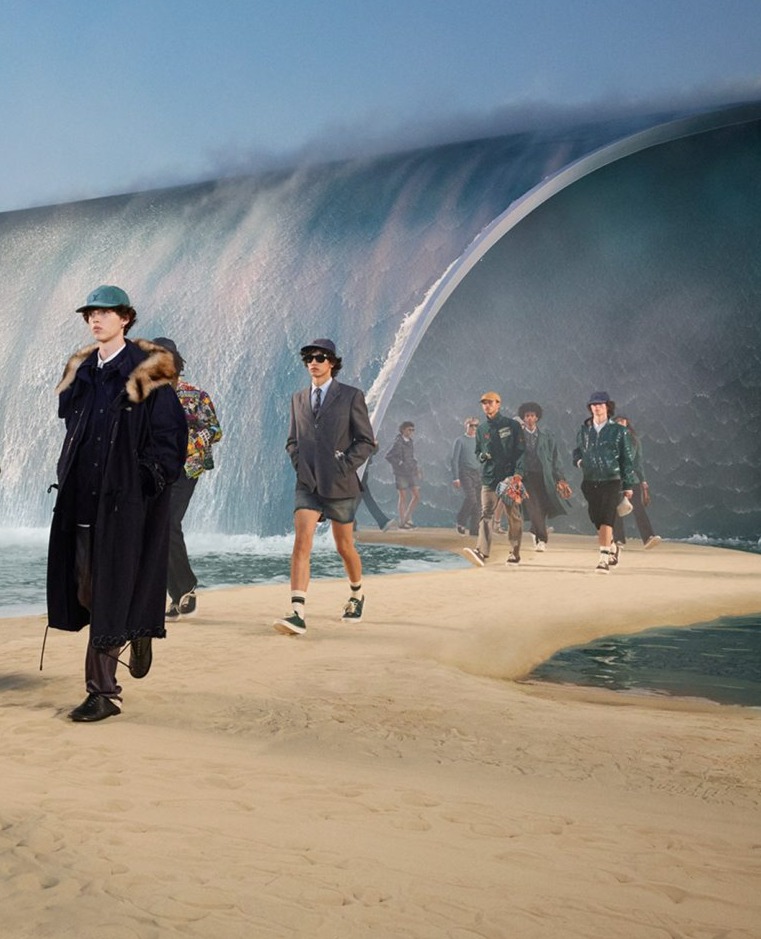
Louis Vuitton Spring-Summer 2027 show in Paris, 2026. Photo by: Louis Vuitton (https://www.dezeen.com/2026/06/25/jumbo-tidal-wave-louis-vuitton-menswear-show/)
Luxury’s Commitment to Sustainability
Intentionally
Most luxury brands have adapted to this new standard fairly quickly with their comprehensive sustainability strategies. One of the most prominent examples of sustainability in luxury is Guerlain. With close to 18 years of unrelenting dedication to sustainability, and continuing, Guerlain has consistently taken the initiative to re-evaluate and protect its longstanding foundations.
Since Guerlain’s brand identity is inspired by bees and its dedication to living nature, the brand has introduced numerous sustainability measures to protect bees and their environment. When it comes to its products – the heart of the brand – Guerlain has built an effective structure to make them as sustainable as possible. Using naturally derived and ethically sourced ingredients, Guerlain’s products are eco-formulated. The products are also designed with refillable options to extend their lifespan. Their packaging now features innovative, eco-friendly materials and construction designed to reduce their carbon footprint. Collectively, these practices contribute to reducing Guerlain’s overall greenhouse gas emissions while minimising the environmental impact of its products throughout their lifecycle. Guerlain also prioritises transparency to allow consumers to better understand the brand’s ethical positioning; therefore, traceability is a core part of their product strategy. Together, these initiatives reflect a sustainability-led product philosophy.
“At Guerlain, product development is guided by a precise understanding of the impact of each ingredient and component” (2).
Creatively
At the same time, sustainability within the luxury framework should not be limited to the production of physical, tangible products. Given the contemporary luxury demographic’s preference for experiences over tangible possessions, sustainability should continue to guide strategic decision-making across the luxury value chain. Therefore, every curated luxury experience should place as much emphasis on sustainable practices as it does on the experience itself. Every component of a luxury experience should be sourced, reused, and disposed of ethically while minimising its environmental impact.
The Louis Vuitton Men’s Spring–Summer 2027 show is a compelling example of how luxury can embrace both extravagance and responsible practices without compromising its creativity or impact. Pharrell Williams, Creative Director of Louis Vuitton Menswear, showcased a surf-inspired Spring–Summer 2027 ready-to-wear collection that captivated the fashion community, turning into one of the season’s most talked-about shows. It was not only the actual collection that attracted attention, but also the construction of the runway. A striking wave-like bridge, with cascading blue water and glistening sand carpeting the entire runway, transformed the Cité Internationale Universitaire de Paris into a surfer’s turf.
Although the show was widely celebrated, it also raised questions about the extent of the brand’s environmental commitments. As part of LVMH’s Regeneration 2030 roadmap, Louis Vuitton supports Coral Gardeners in advancing reef restoration efforts in French Polynesia, while the show’s water, sourced from Eaux de Paris, will return to the sewer system through a closed circuit, and the sand will be donated to the beach volleyball courts at the Cité Internationale Universitaire de Paris (3). This creative vision by Louis Vuitton exemplified how luxury can be realized responsibly and sustainably without compromise.
The Future of Luxury
Over the course of time, nature’s own luxuries have contributed immeasurably to countless expressions of luxury. Although the luxury industry has made considerable progress towards more ethical practices, sustainability remains an ongoing challenge. While many brands have embraced greater environmental and social responsibility, lasting change requires a comprehensive approach that integrates sustainability across every aspect of the industry.
Therefore, a relentless pursuit of change across the luxury industry, regardless of its initial impact, is essential to preserve and regenerate the natural resources upon which it has long relied. This will enable future generations to continue experiencing and appreciating the same luxuries that define the industry today.
Sources:
(1) Håland, W. (1999). On needs — a Central Concept in the Brundtland Report. Towards Sustainable Development, pp.48–69. doi:10.1057/9780230378797_3.
(2) Guerlain (2024). ACTING FOR LIVING BEAUTY – Sustainable Development Report 2024. [online] Available at: https://www.guerlain.com/on/demandware.static/-/Library-Sites-Guerlain_SharedLibrary/default/vd9a268fd1449769468d4a43e8a3d3e8ea2462b22/pdf/RRSE_guerlain_2025_english%201.pdf?version=1,758,626,467,908&_gl=1*t5pdo5*_gcl_au*MjIwNjI5NDQzLjE3ODMzNjQ1MDE.*FPAU*MTYxNTg0NTU1Mi4xNzgzMzY0NTAx*_ga*MjI2Njg2OTE0LjE3NjkxOTg5ODI.*_ga_TL8PLE0B55*czE3ODMzNjQ1MDAkbzIkZzEkdDE3ODMzNjU3MjAkajQ2JGwwJGgxMjAyMTUzMzkwJGRfV0pKakxtOGxwaUtOWnk5TVprRld1S2dyemNqdXBDTmh3*_fplc*SkV3Y3pSMXhGVVNIcjZOcjhQekdFWnRpYkJxS0RSbiUyQlphVlFLb3Y3cFoxUUVtSGJyNzdVS2g1bW93MSUyQnpqQ3ltc3VPUSUyRmwwTSUyQmFyS2NUSG4xMGRhUjNIMTVONVpUWVdpVFZtdGtTdkFCeHBjNWxHMnRxWUM5VFBpNnFUZ1ElM0QlM0Q.
(3) LVMH (2025). Louis Vuitton Unveils Its Men’s Spring-Summer 2027 Show – LVMH. [online] LVMH.com. Available at: https://www.lvmh.com/en/news-lvmh/new-wave-at-the-louis-vuitton-spring-summer-2027-mens-show.
Leave a Reply