How Institutions Legitimize and Preserve the Art of Dress
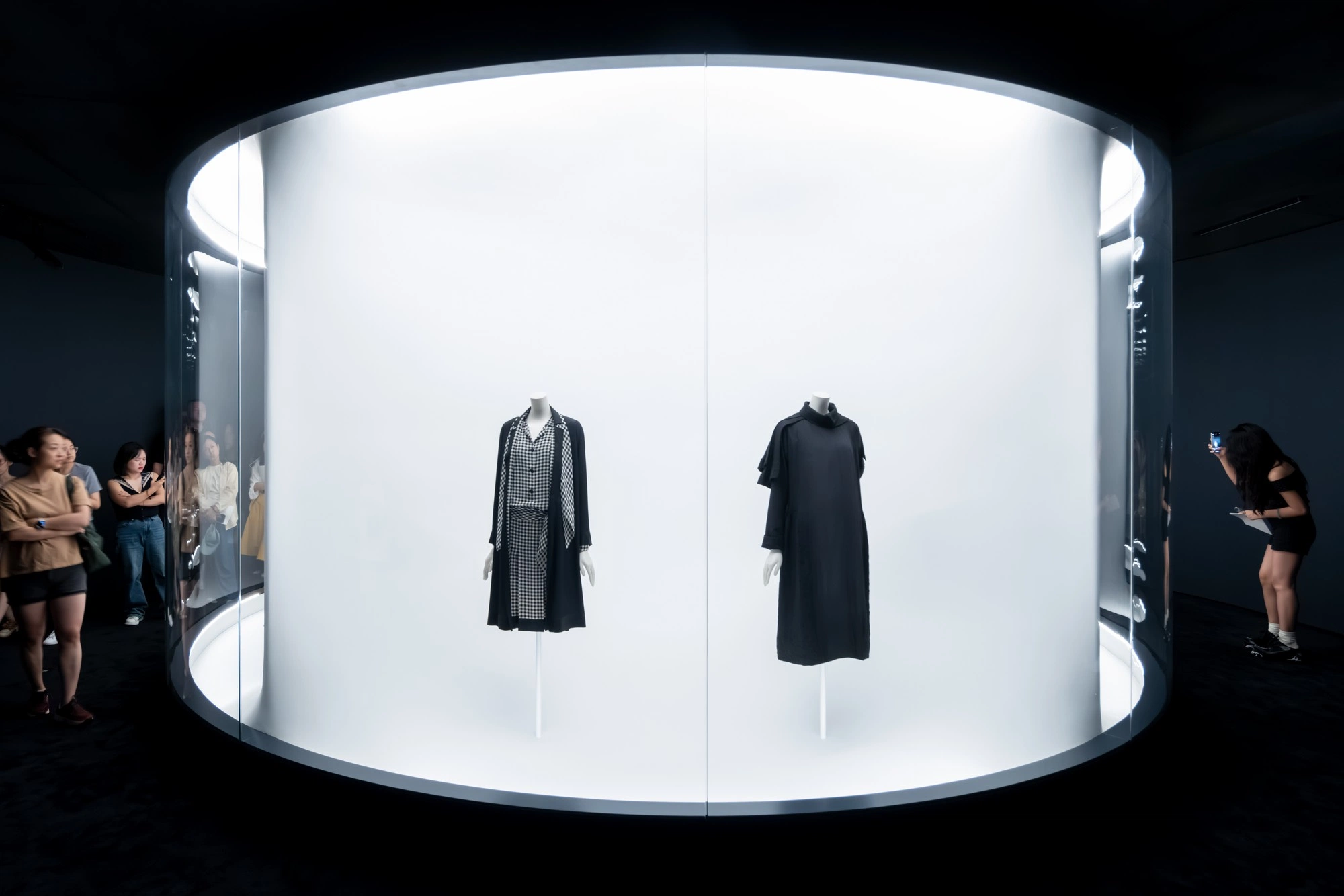
When a museum, MIT, or Palais Galliera puts a dress behind glass, something happens to that dress that has nothing to do with the fabric or the stitching.
The garment is first removed from circulation. It is no longer worn to dinner, photographed on a red carpet, sold through a boutique, or folded back into a private wardrobe. Instead, it is placed into institutional storage, waiting under the same conditions that have long been reserved for paintings and sculptures. Once it enters exhibition, it is presented through controlled lighting, careful display, and the accompanying wall label that tells viewers how to approach it. The dress itself does not change; what changes is its presentation, and that presentation is doing exactly the work museums have always done for objects they decide are worth remembering. Fashion has spent the last several decades asking for this treatment more insistently than any other applied art.
This conversation has a clear historical dimension. A silhouette communicates a narrative the way a painting does. The corseted waist of the 1890s, the dropped waist of the 1920s, the padded shoulder of the 1940s, the cinched waist of Dior’s New Look in 1947. Each of these shapes a body according to what a given decade believed a body should do, how much it should move, how visible it should be, what kind of labor or leisure it was built for. Paul Poiret’s decision to remove the corset in the years before the First World War was read at the time as a design choice, but it was also a statement about how women were expected to occupy space. Dior’s New Look was read by some as pure escapism and by others as a rather blunt argument about where women’s bodies belonged after the war economy had briefly needed them elsewhere.
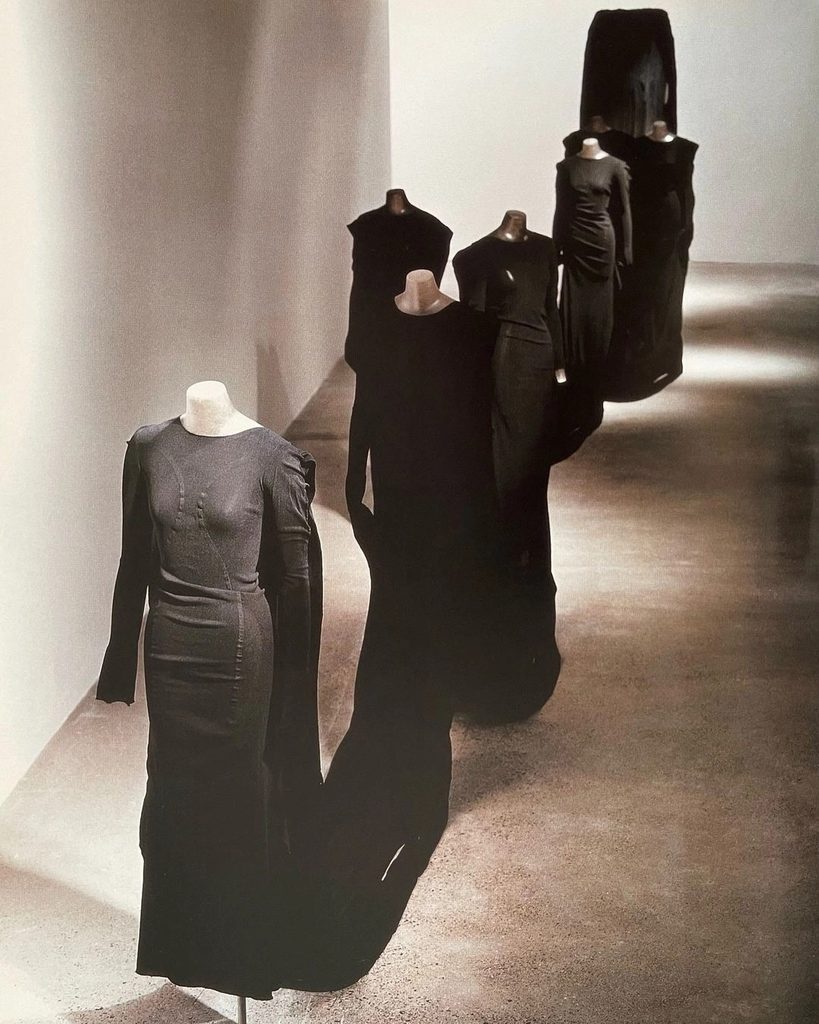
Installation view of the “Just Before” exhibition by Issey Miyake in 1999. (https://www.cosmos.so/e/726618500 )
Together, these shifts show that fashion rarely changes in isolation. Major silhouettes often emerge as visible signals of broader cultural, political, and economic transformations, making garments historical documents as much as aesthetic objects. Neither interpretation requires the dress to hang in a museum to be true. A museum, however, is where that interpretation is preserved beyond the lifetime of the people who experienced it firsthand.
Cristóbal Balenciaga built garments as if he were solving problems in geometry, and by the late 1960s his standing envelope coat and his balloon skirts were being discussed by critics using vocabulary borrowed from sculpture. Alexander McQueen staged collections that functioned as installations before they functioned as clothing lines, a runway with a wind machine and a hologram of Kate Moss doing more to communicate an idea rather than showing a garment. Iris van Herpen works with 3D printing and magnetic fields in a studio that looks closer to a materials-science lab than a traditional atelier, and her pieces have been acquired by institutions like the Museum of Modern Art with the same acquisition logic applied to a piece of contemporary sculpture. None of these designers needed to call themselves artists for the label to attach itself to what they made.
The collaborations between designers and painters are where this intersection becomes most visible, because they intentionally close the gap between the two categories. Elsa Schiaparelli’s work with Salvador Dalí in the late 1930s produced garments that read as Surrealist objects taking shape as clothing. Lobster Dress print has been used in Dalí’s paintings; the Shoe Hat is modeled directly on one of Dalí’s own sketches. Schiaparelli was translating these surrealist pieces into a brand-new medium that could be worn to a party or to a fancy dinner. These collaborations also elevated her maison beyond dressmaking. By aligning her work with one of the defining artists of the twentieth century, Schiaparelli positioned haute couture as a legitimate participant in artistic discourse rather than merely a producer of fashionable clothing.
Nearly a century later, Louis Vuitton’s collaborations with Yayoi Kusama, first in 2012 and again in 2023, worked from a similar idea but different tools: Kusama’s polka dots and infinity nets applied across handbags, trunks, and ready-to-wear, with storefronts around the world transformed into installations featuring a giant animatronic Kusama painting dots onto a canvas in the window. The commercial scale of that second collaboration was enormous, but the gesture was the same one Schiaparelli had made decades earlier: an artist’s visual language grafted directly onto the surface of a garment which could be perfectly wearable. What ties the historical and the recent collaborations together is that in both cases the fashion house needed the artist’s authority to make a claim about itself. Schiaparelli needed Dalí to show that her house could produce Surrealism as convincingly as it produced eveningwear. Louis Vuitton needed Kusama to show that a maison built on monogrammed trunks could still speak the language of contemporary art. A museum retrospective borrows the authority of an institution. A collaboration borrows the authority of an individual artist. Both allow garments to reach a cultural status that might otherwise take decades to achieve, if they achieve it at all.
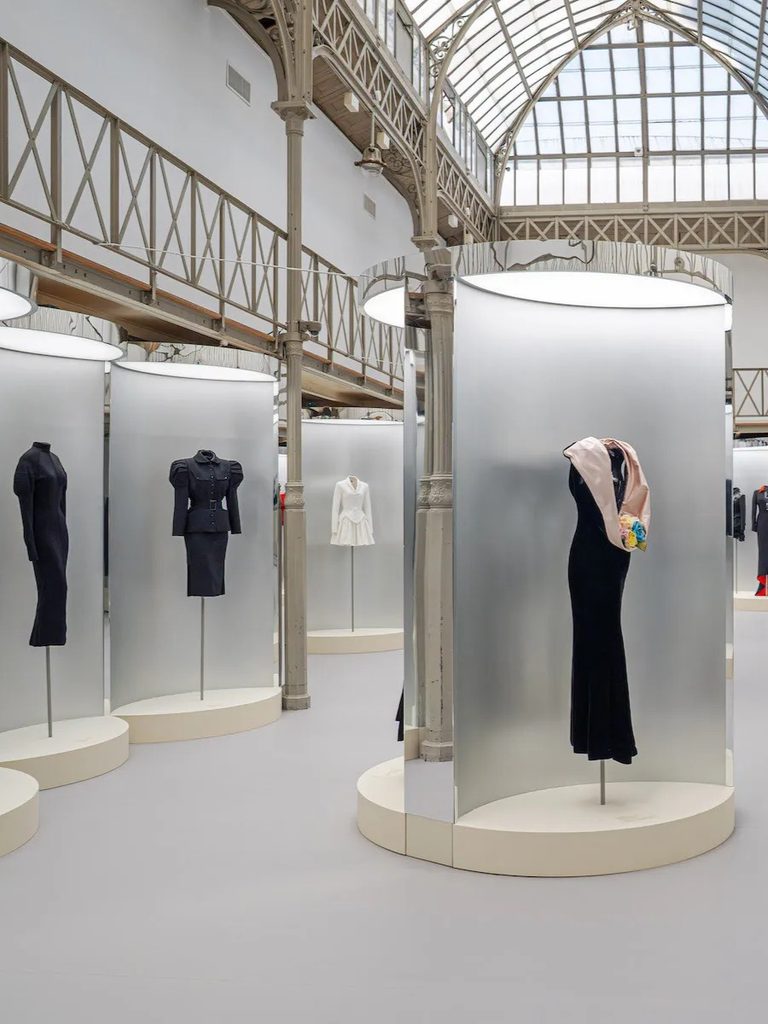
‘Azzedine Alaïa – Thierry Mugler: 1980-1990 Two Decades of Artistic Affinities’ at Fondation Azzedine Alaïa, Paris 2025. Photo by: Stéphane Aït Ouarab (https://www.wallpaper.com/fashion-beauty/azzedine-alaia-thierry-mugler-paris-exhibition)
For today’s luxury consumer, these collaborations represent more than successful marketing campaigns. Purchasing such a garment or accessory is also the acquisition of cultural capital. The object carries the symbolic authority of the artist whose work it incorporates. This helps explain why the intersection between fashion and art has become one of the defining characteristics of the contemporary luxury industry. Haute couture has long justified its value through extraordinary craftsmanship, but increasingly it also justifies itself through intellectual and artistic associations. In this context, luxury is measured not only by exclusivity or technical excellence, but by a garment’s ability to participate in wider cultural conversations.
That is probably the simplest way to describe what a museum does for a dress – it buys the garment time. A painting gets studied across centuries because someone decided early on that it was worth keeping past the death of everyone who understood its original context. Every viewer past that generation inherits knowledge of that period, instead of having to start from nothing. Clothing rarely gets that kind of a head start, since it is made to be worn, damaged, and altered. The majority of the garments that survive past their time are just pieces someone happened to hold onto. A museum purposefully breaks that linear process. It is truly the only institution built to insist that a coat from 1912 deserves the same care as a painting from the same year, and the fact that this insistence is even necessary says something about how fashion has been treated all along.
Looking forward, this approach should become less of an exception and more of a standard. As museums continue expanding their fashion collections and collaborations between artists and designers become increasingly common, garments should be evaluated not only for their craftsmanship or commercial success but also for their cultural, historical, and artistic significance. Fashion is one of the most immediate records of how societies imagine identity, status, technology, and beauty. Preserving it accordingly allows future generations to study these ideas with the same seriousness afforded to painting, sculpture, or architecture. If museums give fashion time, scholarship must continue giving it attention.
Leave a Reply