Category: Architecture of luxury

  • The FOMO Economy

    The FOMO Economy

    How Luxury Learned to Monetise the Scarcity Mindset

    For most of its history, the luxury industry sold objects whose rarity could be traced back to something physical. A Kashmir sapphire is rare because the mines above Padar were largely depleted by the 1930s. A Patek Philippe minute repeater is rare because the number of people capable of tuning its gongs is limited and shrinking. Hermès trains a leather artisan for two years before that person is allowed to finish a bag independently , and the output level of a workshop is limited by the number of employees inside it. In each case, the scarcity exists outside the brand’s marketing department. A buyer paying for rarity was paying for a shortage that existed whether or not anyone was looking.

    The economics of such a business model stopped matching the size of the industry sometime in the last two decades. The large conglomerates now report revenues in the tens of billions of euros, and speak to audiences measured in the hundreds of millions on Instagram. Hermès produces more Birkins today than it did ten years ago, and the waiting times have not shortened. The concept of scarcity in luxury lives on, but it has moved from production limitations to being the heart of the new distribution model. The shortage an individual client experiences is increasingly a shortage of permission to consume rather than a shortage of goods and services, which changes how the act of buying feels. The question shifts from whether an object is rare to whether the opportunity to acquire it will still exist next season.

    Jewelry by Fernando Jorge at his New York showroom, designed by Andre Mellone. Photo by: Billal Baruk Taright (https://www.cosmos.so/e/797450311)

    The waitlist is the oldest of these instruments and the least honest about what it truly is. Hermès has never admitted to the existence of a formal Birkin list, which is true in some sense, because it is instead a purchase history a sales associate reads before deciding what to offer. Ferrari makes the logic explicit: access to a limited series such as the LaFerrari Aperta was restricted to collectors with an existing ownership record. The wait is not a delay in the transaction. It is part of the buying decision, because the time spent qualifying becomes evidence that the object was difficult to obtain, whilst allowing time to personalise the sale for the customers that do qualify.

    This limited-edition drop delivers the same concept in a much tighter window. A product exists for a defined timeline, and the decision to buy is made under time pressure rather than after proper reflection. When Patek Philippe discontinued the Nautilus 5711 in 2021 and released a final green-dial run, resale prices on the secondary market climbed to several times the original retail price almost immediately, with no change to the watch itself. The sold-out label completes the picture. Absence communicates more powerfully than availability, and a brand that sells out quickly has demonstrated demand in a way no campaign can.

    The invitation is arguably the most valuable of these tools because it cannot be acquired directly. Private salons above the boutiques on Place Vendôme, high jewellery previews held during couture week, dinners attached to a fair, first access to a collection before it is catalogued: none of these appear in a product assortment. They are distributed on the basis of the client-brand relationship, and the client who receives one has been evaluated and chosen rather than served. 

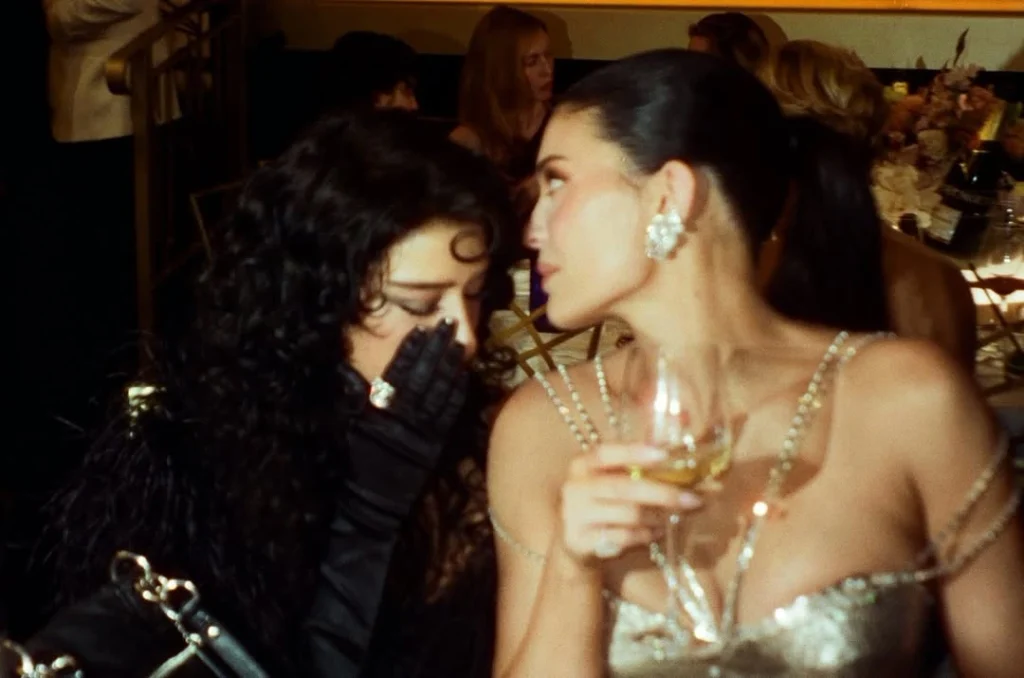
    Kylie Jenner and Odessa A’zion at the 83rd Annual Golden Globe Awards. Photo by: German Larkin (https://www.cosmos.so/e/145211867)

    A collector who was not invited to a dinner in Geneva would most likely never learn the dinner had taken place, and the social cost of exclusion used to be low because exclusion was invisible. Instagram removed that confinement, and now the guest list, the table, the pieces shown, and the people shown in them circulate publicly within minutes. The effect is asymmetric: the number of people who see an event has grown by several orders of magnitude while the number of people admitted has stayed constant or fallen. Visibility, which the industry pursued as a growth strategy, turned out to be the mechanism that takes away accessibility.

    The limit of the model is that engineered scarcity depends on whether it is believed. When every capsule is limited, every dinner is private, and every release is a limited edition, it loses its information value, and clients begin to read the mechanism rather than the object. Scarcity fatigue is difficult to measure from the inside, because the queue is still there and the product still sells out.

  • Creating Viral Moments: How Luxury Startups Turn Attention Into Brand Desire

    Creating Viral Moments: How Luxury Startups Turn Attention Into Brand Desire

    For most contemporary brands, going viral is the ultimate goal. But for luxury, mass exposure can threaten the exclusivity and mystique that traditionally fueled desire. Yet social media has made mass attention almost indistinguishable from cultural relevance, leaving luxury brands with a more complicated question: how do you become part of the conversation without becoming too familiar? (Creevey, Coughlan and O’Connor, 2022).

    The distinction between visibility and desirability is important because visibility alone does not create desire. Research on luxury brand growth has found that awareness can increase desirability, while excessive market penetration can weaken it (Kapferer and Valette-Florence, 2018). Therefore, a viral moment can be seen by millions and still do very little for the brand behind it. What matters is the feeling that kind of attention triggers in viewers: curiosity, aspiration, proximity, or the sense that they are looking at something they want to be part of.

    This is where the idea of the viral moment becomes increasingly viable for luxury. The strongest examples are rarely about simply putting a product in front of as many people as possible. They create something people want to talk about: an unexpected collaboration, an installation worth photographing, an invitation that cannot be easily obtained, or a detail that leaves just enough unanswered. The moment spreads, but the feeling of access remains selective.

    For luxury startups, the challenge is not to choose between attention and exclusivity. It is to design moments where one creates the other.

    A behind-the-scenes look at a photoshoot for the collection THE DROP. Photo by: THE DROP Staff (https://www.cosmos.so/e/649921880)

    Why Traditional Virality Conflicts With Luxury Positioning

    Traditional viral marketing is built around removing barriers. The easier something is to see, understand, reproduce, and share, the further it can travel. Luxury has historically created desire through a different set of signals: rarity, selectivity, and the feeling that access is not equally available to everyone. Social media brings these two systems into direct contact, giving consumers more power to create and distribute brand-related content while making exclusivity harder to control (Creevey, Coughlan and O’Connor, 2022).

    The tension, however, is not simply between being visible and being exclusive. Research on 60 major luxury brands across six countries found that awareness consistently increases desirability, while greater brand penetration can have the opposite effect (Kapferer and Valette-Florence, 2018). In other words, luxury does not need less attention. In other words, the challenge is not to limit attention, but to ensure that greater visibility does not come at the expense of desirability.

    This makes the mechanics of virality particularly impactful. A moment that reaches millions can strengthen a brand by giving those audiences something distinctive to recognise and desire. But simply adding restrictions or making content harder to access is not enough. Recent research about scarcity-based communication on Instagram found that scarcity can reduce perceived exclusivity when it fails to generate consumer interest, with brand familiarity influencing the effect (Godey et al., 2025). 

    The real question, then, lies in the gap between reach and desire. A successful viral moment for luxury should not be hidden from the majority. It has to give people a reason to care about seeing it, talking about it, or being close to it, while preserving a sense of access and experience that social media alone cannot provide.

    Visibility Is Not Desirability

    A million views tell a brand how far a moment travelled. They do not reveal what the audience wanted from it. In luxury, that distinction is exceptionally crucial: consumers engage with brands not only because they recognise them, but because the content reflects how they see themselves: through aesthetics, entertainment, self-expression, or status (Bazi, Filieri and Gorton, 2020).

    This changes the role of the audience. The person sharing a luxury moment is not simply distributing the brand’s message; they are equating it to their own identity. Research on luxury social media engagement has found that brand self-expressiveness is a significant driver of engagement, which can in turn strengthen brand image and loyalty (Gummerus et al., 2020). The most valuable interaction is not necessarily the one that generates another impression; it is the one that allows the person sharing it to express themselves.

    This also explains why a highly visible moment can still feel strangely empty. If the audience has nothing to gain beyond having seen it, there is little reason for the moment to travel further. The strongest luxury content gives people something to signal: taste, cultural awareness, proximity, or simply the fact that they noticed something before it became familiar. Recent research similarly finds that digital word-of-mouth can support luxury brand equity while remaining compatible with an exclusivity positioning (Casais et al., 2025)

    The measure of a successful viral moment, therefore, is not only how many people saw it. It is whether they left wanting something that interaction could not provide: the product, the experience, the access, or the feeling of belonging to the world around the brand.

    Talkability Without Becoming Mainstream

    The most impactful luxury moments are rarely the ones that explain themselves. They leave something for the audience to capture, interpret, speculate about, or pass between people. That unfinished quality gives a brand conversation a life beyond the original campaign.

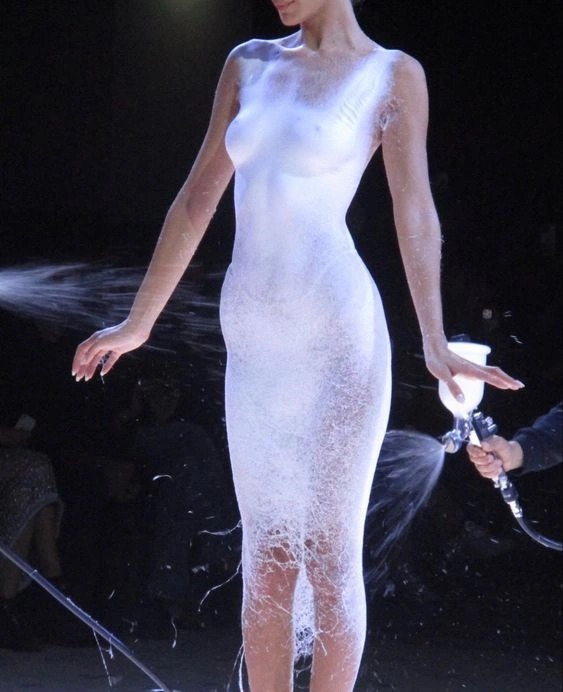
    Model Bella Hadid wears a spray-on dress from Coperni’s Spring 2023 show at Paris Fashion Week. (https://www.cosmos.so/e/1401601474) 

    Coperni’s 2022 spray-on dress is a useful example. During its Spring/Summer 2023 show, Bella Hadid walked onto the runway in underwear before scientists sprayed a liquid directly onto her body, turning it into a fitted white dress in minutes. Coperni’s 2022 spray-on dress is a useful example. During its Spring/Summer 2023 show, Bella Hadid walked onto the runway in underwear before scientists sprayed a liquid directly onto her body, turning it into a fitted white dress in minutes. The technology was real, but the spectacle was almost theatrical: it was less a product demonstration than a moment designed to be witnessed. Within 48 hours, the activation generated an estimated $26.3 million in media impact value, while Coperni’s Instagram following jumped from 315,000 to 552,000 (Maguire, 2022).

    What made the moment travel was not simply novelty. It gave people something to talk about beyond the clothes themselves: how the material worked, whether it could become a real garment, and what they had just watched unfold on the runway.

    That level of recognition creates a different kind of visibility, one where the brand becomes part of the conversation rather than simply being seen. The brand did not make every part of the experience readily accessible; it created an event that could be endlessly reproduced through images and video while remaining impossible to experience in exactly the same way. The original moment belonged to the runway. Everything that followed was its echo.

    For a luxury startup, this distinction matters. The objective is not simply to give people something to share. It is to create a moment, the meaningfulness of which expands as it travels, without making the brand itself feel ordinary.

    Designing Moments People Want to Share

    True shareability occurs when an experience shifts from passive viewing to active participation. Research into engagement with social media accounts of luxury brands points to several recurring drivers, including entertainment, aesthetics, authenticity, inspiration and social status (Bazi, Filieri and Gorton, 2020). The implication is simple: the product does not have to be the entire story. Sometimes, the experience surrounding it is what makes people want to pass it on.

    This is where the design of the moment matters. The strongest activations usually contain something immediately recognisable, something unexpected, and something that rewards a second look. This is where the design of the moment matters. The strongest activations usually contain something immediately recognisable, something unexpected, and something that rewards a second look. They should be immediately understandable, while still leaving enough ambiguity to reward a second look. That tension gives the audience a reason to pause before giving them a reason to share.

    Gentle Monster has built much of its retail strategy around this principle. Its stores are designed less as conventional points of sale than as immersive environments, filled with oversized sculptures, moving figures, and surreal installations. The products remain present, but the store itself becomes the destination. The experience is therefore easy to photograph and circulate without reducing the brand to a single product image (Kim, 2023).

    This lesson is especially relevant for startups. A shareable moment does not necessarily require a large budget or an elaborate production. It needs a clear idea that can be understood instantly and remembered afterwards. The strongest moments give people an image, an emotion, or a story they can carry elsewhere, while keeping enough of the brand’s world intact for the audience to be able to spot and recognise where it came from.

    In luxury, the most effective viral moment is therefore not the one that asks to be shared. It is the one that makes sharing feel like part of the experience.

    From Viral Moment to Brand Desire

    A viral moment can put a brand into the conversation. It cannot, on its own, give that conversation meaning. For a luxury startup, the real test comes after the attention: does the moment make the brand more recognisable, more culturally relevant, or more desirable?

    This is where consistency becomes integral. The most effective moments are not isolated acts of spectacle; they feel like extensions of a world the brand has already been building. Coperni’s sense of technology and experimentation made its spray-on dress feel like more than a stunt. Gentle Monster’s surreal retail environments work for the same reason: the spectacle is not separate from the brand, but an expression of how it wants to be experienced.

    The distinction is easy to miss. A brand can engineer an enormous spike in attention and still leave consumers with nothing to remember beyond the event itself. Luxury startups lack room for that disconnection because they are often still teaching the market what the brand stands for. Every highly visible moment therefore does two jobs at once: it attracts attention and defines the brand.

    The value of a viral moment therefore lies not only in the attention it generates, but in its ability to strengthen the associations consumers form with the brand.

    Conclusion

    For luxury startups, the goal is not to avoid mass attention, but to control what that attention communicates. A viral moment is valuable when it creates recognition without exhausting the sense of discovery that makes a brand desirable.

    This will become more difficult as social platforms become increasingly crowded and AI makes the production of attention-grabbing content faster and cheaper. The advantage will therefore shift from simply creating something visually striking to creating moments that are difficult to replicate because they are rooted in a distinctive product, place, experience, or brand idea. For emerging luxury brands, virality will matter less as a measure of how many people saw them and more as a test of whether people remember what made them different.


    References

    1. Bazi, S., Filieri, R. and Gorton, M. (2020) ‘Customers’ Motivation to Engage with Luxury Brands on Social Media’, Journal of Business Research, 112, pp. 223–235.
      https://doi.org/10.1016/j.jbusres.2020.02.032⁠
    2. Casais, B., Soares, A.M., Abreu, M., Lungu, D. and Rodrigues, J. (2025) ‘“Look at What I Own”: The Role of Social Media in Luxury Brand Equity and Conspicuous Consumption’, Asia Pacific Journal of Marketing and Logistics, 38(7), pp. 2035–2050.
      https://doi.org/10.1108/APJML-03-2025-0403⁠
    3. Creevey, D., Coughlan, J. and O’Connor, C. (2022) ‘Social Media and Luxury: A Systematic Literature Review’, International Journal of Management Reviews, 24(1), pp. 99–129.
      https://doi.org/10.1111/ijmr.12271⁠
    4. Kapferer, J.-N. and Valette-Florence, P. (2018) ‘The Impact of Brand Penetration and Awareness on Luxury Brand Desirability: A Cross Country Analysis of the Relevance of the Rarity Principle’, Journal of Business Research, 83, pp. 38–50.
      https://doi.org/10.1016/j.jbusres.2017.09.025⁠
    5. Lim, H., Childs, M., Cuevas, L. and Lyu, J. (2021) ‘Between You and Me: The Effects of Content Ephemerality and the Role of Social Value Orientation in Luxury Brands’ Social Media Communication’, Journal of Global Fashion Marketing, 12(2), pp. 120–132.
      https://doi.org/10.1080/20932685.2021.1881579⁠
    6. Maguire, L. (2022) ‘A Spray-On Dress and a Solid Gold Bag: Coperni Goes After Gen Z With Novelty and Fun’, Vogue Business, 1 October.
      Vogue Business article⁠
    7. Nechaeva, O., Dasmia, C., Mazzoli, V., Vannucci, V. and Donvito, R. (2025) ‘Scarcity in Luxury Brand Digital Communication: Unveiling Its Effect on Consumer Perceptions’, International Journal of Advertising, 44(7), pp. 1195–1226.
      https://doi.org/10.1080/02650487.2024.2427516⁠
    8. Oliveira, M. and Fernandes, T. (2022) ‘Luxury Brands and Social Media: Drivers and Outcomes of Consumer Engagement on Instagram’, Journal of Strategic Marketing, 30(4), pp. 389–407.
      https://doi.org/10.1080/0965254X.2020.1777459⁠
  • From Runway to Exhibition: Fashion Needs Museums

    From Runway to Exhibition: Fashion Needs Museums

    How Institutions Legitimize and Preserve the Art of Dress

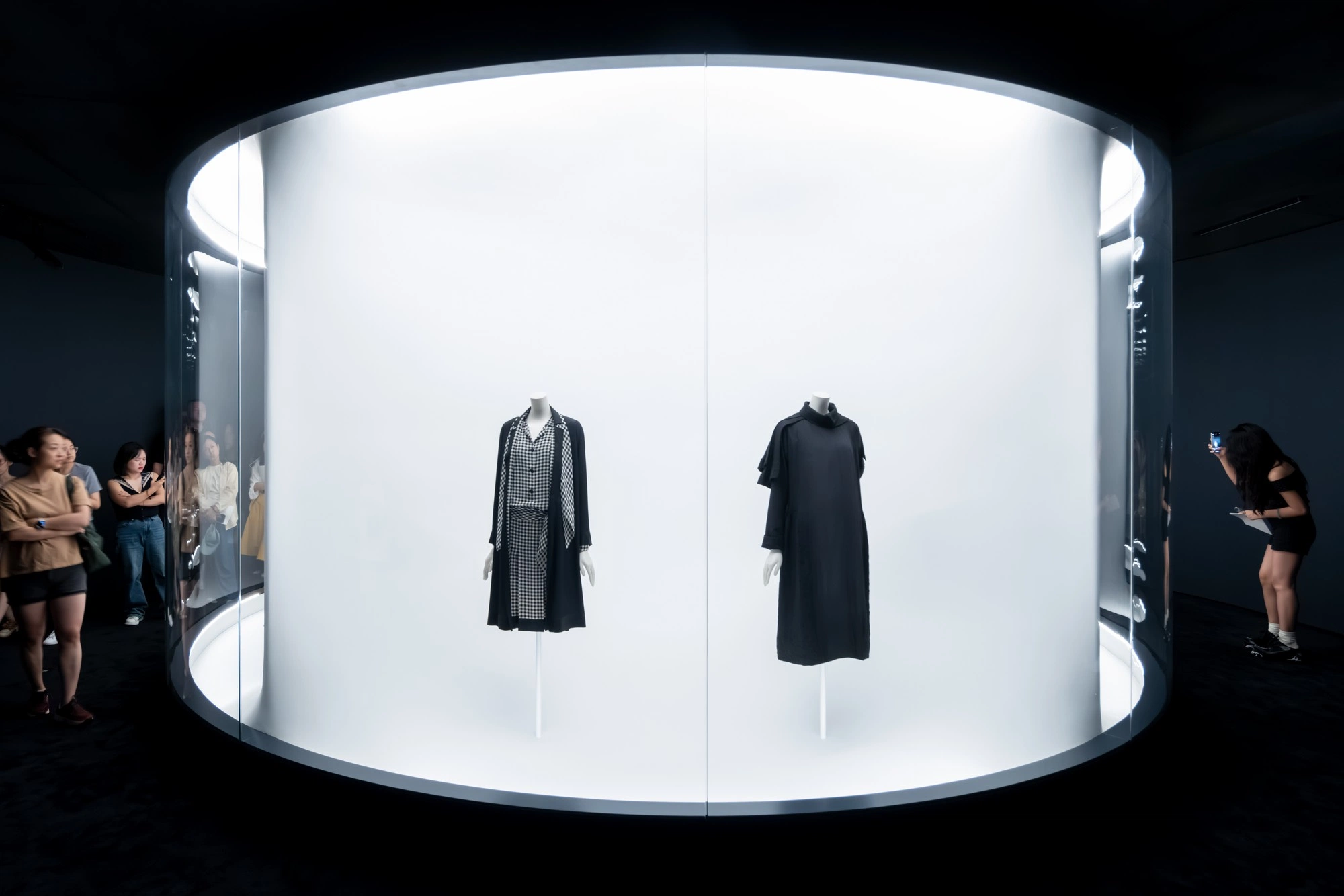
    When a museum, MIT, or Palais Galliera puts a dress behind glass, something happens to that dress that has nothing to do with the fabric or the stitching. 

    The garment is first removed from circulation. It is no longer worn to dinner, photographed on a red carpet, sold through a boutique, or folded back into a private wardrobe. Instead, it is placed into institutional storage, waiting under the same conditions that have long been reserved for paintings and sculptures. Once it enters exhibition, it is presented through controlled lighting, careful display, and the accompanying wall label that tells viewers how to approach it. The dress itself does not change; what changes is its presentation, and that presentation is doing exactly the work museums have always done for objects they decide are worth remembering. Fashion has spent the last several decades asking for this treatment more insistently than any other applied art.

    This conversation has a clear historical dimension. A silhouette communicates a narrative the way a painting does. The corseted waist of the 1890s, the dropped waist of the 1920s, the padded shoulder of the 1940s, the cinched waist of Dior’s New Look in 1947. Each of these shapes a body according to what a given decade believed a body should do, how much it should move, how visible it should be, what kind of labor or leisure it was built for. Paul Poiret’s decision to remove the corset in the years before the First World War was read at the time as a design choice, but it was also a statement about how women were expected to occupy space. Dior’s New Look was read by some as pure escapism and by others as a rather blunt argument about where women’s bodies belonged after the war economy had briefly needed them elsewhere. 

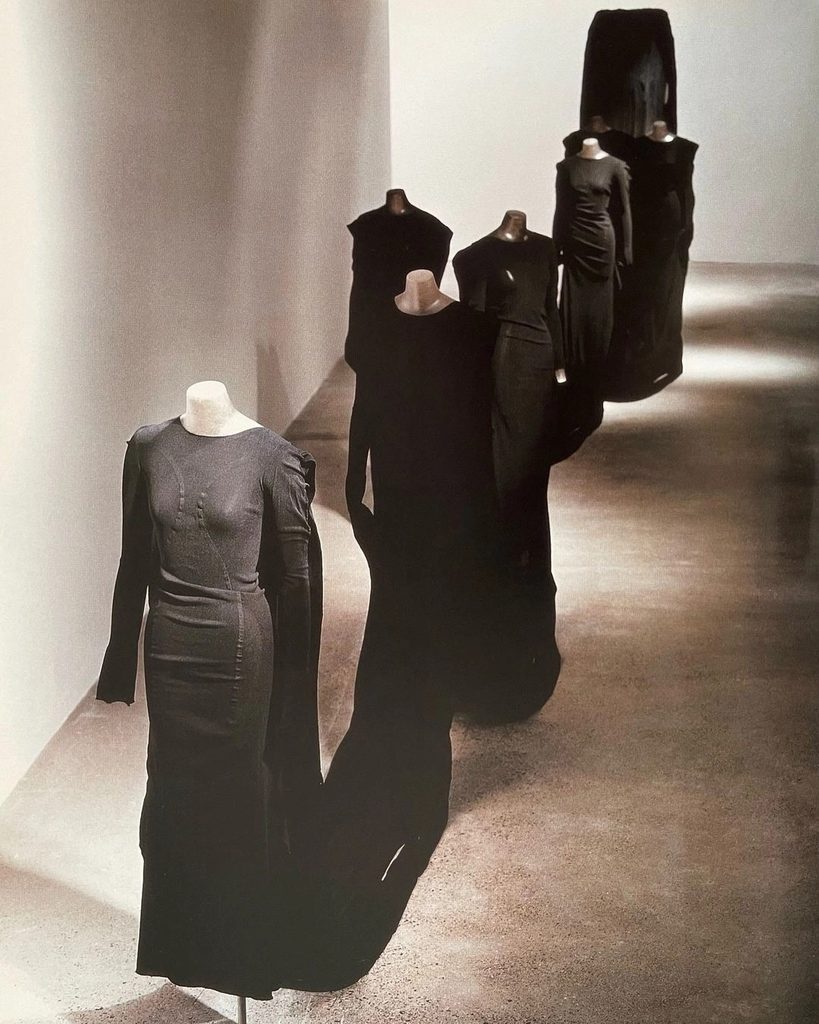
    Installation view of the “Just Before” exhibition by Issey Miyake in 1999. (https://www.cosmos.so/e/726618500 )

    Together, these shifts show that fashion rarely changes in isolation. Major silhouettes often emerge as visible signals of broader cultural, political, and economic transformations, making garments historical documents as much as aesthetic objects. Neither interpretation requires the dress to hang in a museum to be true. A museum, however, is where that interpretation is preserved beyond the lifetime of the people who experienced it firsthand.

    Cristóbal Balenciaga built garments as if he were solving problems in geometry, and by the late 1960s his standing envelope coat and his balloon skirts were being discussed by critics using vocabulary borrowed from sculpture. Alexander McQueen staged collections that functioned as installations before they functioned as clothing lines, a runway with a wind machine and a hologram of Kate Moss doing more to communicate an idea rather than showing a garment. Iris van Herpen works with 3D printing and magnetic fields in a studio that looks closer to a materials-science lab than a traditional atelier, and her pieces have been acquired by institutions like the Museum of Modern Art with the same acquisition logic applied to a piece of contemporary sculpture. None of these designers needed to call themselves artists for the label to attach itself to what they made.

    The collaborations between designers and painters are where this intersection becomes most visible, because they intentionally close the gap between the two categories. Elsa Schiaparelli’s work with Salvador Dalí in the late 1930s produced garments that read as Surrealist objects taking shape as clothing. Lobster Dress print has been used in Dalí’s paintings; the Shoe Hat is modeled directly on one of Dalí’s own sketches. Schiaparelli was translating these surrealist pieces into a brand-new medium that could be worn to a party or to a fancy dinner. These collaborations also elevated her maison beyond dressmaking. By aligning her work with one of the defining artists of the twentieth century, Schiaparelli positioned haute couture as a legitimate participant in artistic discourse rather than merely a producer of fashionable clothing.

    Nearly a century later, Louis Vuitton’s collaborations with Yayoi Kusama, first in 2012 and again in 2023, worked from a similar idea but different tools: Kusama’s polka dots and infinity nets applied across handbags, trunks, and ready-to-wear, with storefronts around the world transformed into installations featuring a giant animatronic Kusama painting dots onto a canvas in the window. The commercial scale of that second collaboration was enormous, but the gesture was the same one Schiaparelli had made decades earlier: an artist’s visual language grafted directly onto the surface of a garment which could be perfectly wearable. What ties the historical and the recent collaborations together is that in both cases the fashion house needed the artist’s authority to make a claim about itself. Schiaparelli needed Dalí to show that her house could produce Surrealism as convincingly as it produced eveningwear. Louis Vuitton needed Kusama to show that a maison built on monogrammed trunks could still speak the language of contemporary art. A museum retrospective borrows the authority of an institution. A collaboration borrows the authority of an individual artist. Both allow garments to reach a cultural status that might otherwise take decades to achieve, if they achieve it at all.

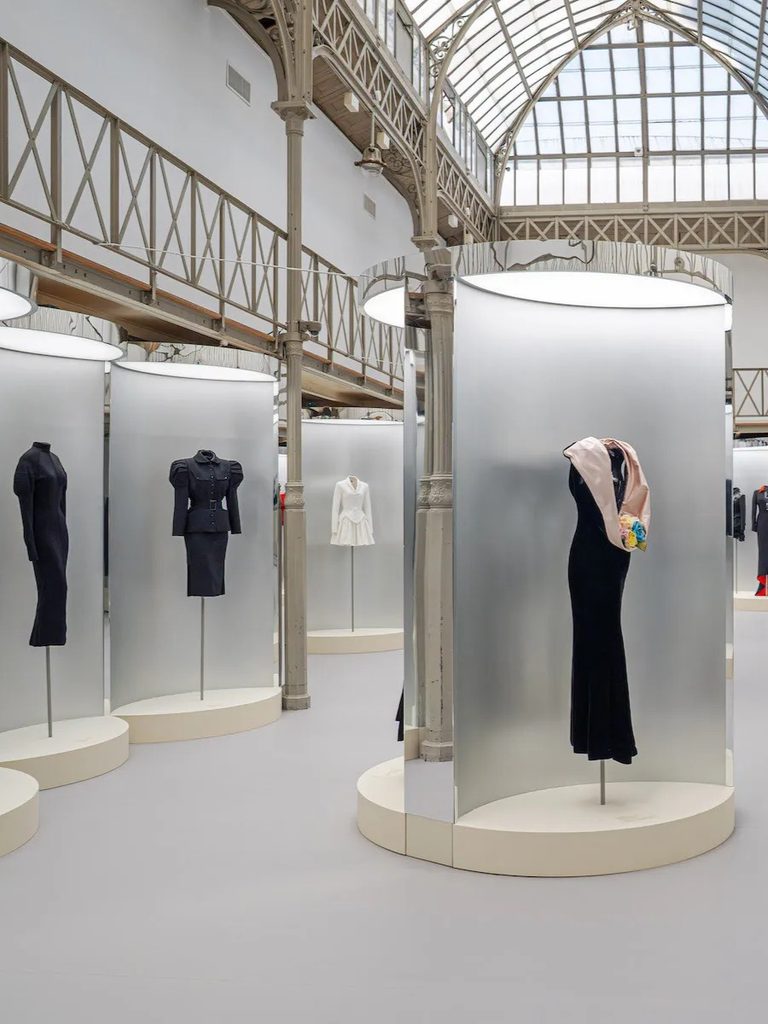
    ‘Azzedine Alaïa – Thierry Mugler: 1980-1990 Two Decades of Artistic Affinities’ at Fondation Azzedine Alaïa, Paris 2025. Photo by: Stéphane Aït Ouarab (https://www.wallpaper.com/fashion-beauty/azzedine-alaia-thierry-mugler-paris-exhibition)

    For today’s luxury consumer, these collaborations represent more than successful marketing campaigns. Purchasing such a garment or accessory is also the acquisition of cultural capital. The object carries the symbolic authority of the artist whose work it incorporates. This helps explain why the intersection between fashion and art has become one of the defining characteristics of the contemporary luxury industry. Haute couture has long justified its value through extraordinary craftsmanship, but increasingly it also justifies itself through intellectual and artistic associations. In this context, luxury is measured not only by exclusivity or technical excellence, but by a garment’s ability to participate in wider cultural conversations.

    That is probably the simplest way to describe what a museum does for a dress – it buys the garment time. A painting gets studied across centuries because someone decided early on that it was worth keeping past the death of everyone who understood its original context. Every viewer past that generation inherits knowledge of that period, instead of having to start from nothing. Clothing rarely gets that kind of a head start, since it is made to be worn, damaged, and altered. The majority of the garments that survive past their time are just pieces someone happened to hold onto. A museum purposefully breaks that linear process. It is truly the only institution built to insist that a coat from 1912 deserves the same care as a painting from the same year, and the fact that this insistence is even necessary says something about how fashion has been treated all along. 

    Looking forward, this approach should become less of an exception and more of a standard. As museums continue expanding their fashion collections and collaborations between artists and designers become increasingly common, garments should be evaluated not only for their craftsmanship or commercial success but also for their cultural, historical, and artistic significance. Fashion is one of the most immediate records of how societies imagine identity, status, technology, and beauty. Preserving it accordingly allows future generations to study these ideas with the same seriousness afforded to painting, sculpture, or architecture. If museums give fashion time, scholarship must continue giving it attention.

  • Beyond Status: How Sustainability Redefines Desirability in Luxury

    Beyond Status: How Sustainability Redefines Desirability in Luxury

    Across generations, indulgence in luxury has been a deep sense of pride for many individuals, with the desire for it only intensifying over time. Oftentimes, luxury has been the perfect language to translate one’s identity, values, and social position, but, most importantly, the richness and fulfillment of one’s existence. This very essence of luxury begins with nature’s unparalleled contribution to its creation.

    Luxury’s Silent Source

    To this day, the luxury industry remains heavily reliant on nature and its resources in the development of its creations. Nature contributes to the quality, craftsmanship, and distinctiveness associated with luxury, shaping the standards of excellence expected across the industry. Centered on intentionality and exclusivity, luxury’s dedication to crafting excellence begins with nature’s resources. From creative conception and design to exceptional craftsmanship, continuous innovation, and premium experiences, luxury is supported by nature’s endowments at every level.

    Whether directly or indirectly, most tangible luxury products depend on nature’s finest resources. Each industry in the luxury market relies on its own combination of resources, such as flowers for fragrances, cotton and leather for fashion, grapes for wine, and precious metals and gemstones for jewelry and watches. This dependence has, over time, placed considerable strain on the environment and the sources that have sustained it. Although the integration of alternative materials has gradually reduced reliance on certain resources over the past decade, the luxury industry has no intention of operating independently of nature, which has long been central to its creations beyond raw materials. 

    In recent years, the escalation of production and consumption has increased the strain on nature’s resources. Despite lower production volumes than the mass and premium markets, the luxury industry’s reliance on resource-intensive materials such as leather, precious metals, gemstones, fine textiles, and natural ingredients has significant environmental implications. The extraction and processing of these materials require substantial amounts of land, water, and energy while generating carbon emissions and disrupting biodiversity. Beyond the industry’s own resource demands, the strain is further intensified by a growing global population, climate volatility, and the absence of viable means to manage previously accumulated excess. At the same time, the rapidly increasing levels of consumption have become increasingly normalised, allowing the overconsumption of natural resources to go largely unnoticed.  This has called for a serious reassessment of the unsustainable practices and resource consumption across the global luxury market. 

    Such realities raise a compelling question: if luxury is intended to make life more comfortable and indulgent, at whose expense is that comfort achieved?

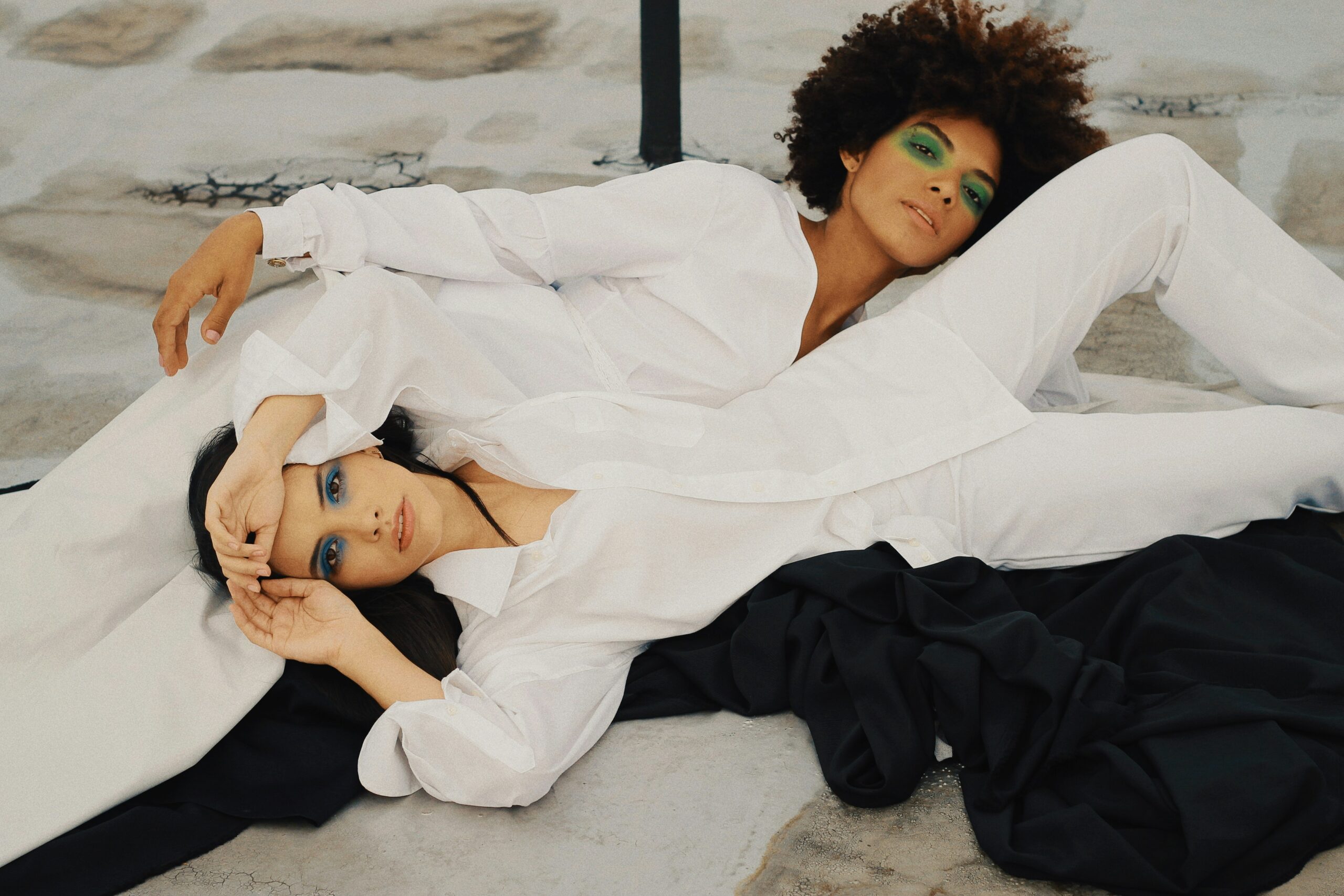
    Photo by: Parker Coffman, 2020    (https://unsplash.com/photos/white-dress-shirt-hanged-on-brown-wooden-clothes-hanger-nAJEr8KlUnE) 

    Luxury’s New Desirability Feature

    Neither nature nor future generations should have to bear the cost of today’s comfort. This represents a defining shift in how luxury is conceived, created, and presented to its audience. 

    In contemporary luxury, one of the most prominent and debated factors in desirability is sustainability. At a time when luxury has become a common expression of identity and values, its commitment to the environment and society is what makes luxury, luxury. A sustainable structure across all aspects of luxury is fundamental to its ethical framework. It is the ability to meet the customer’s needs without compromising the ability of future generations to meet their own (1). 

    Surpassing all previous generations, today’s luxury consumers place a stronger emphasis on identity, social and cultural standing, meaningful experiences, and heritage. Their appreciation of intentionality deepens when it closely aligns with their value system. Likewise, their perception of exclusivity is increasingly defined by thoughtfulness and responsible resource management rather than by scarcity alone. Therefore, individuals place greater value on responsibly produced luxury than on unethically sourced rare products. This has become the new standard for the new generations of luxury consumers. Quality, craftsmanship, and innovation, driven by the need to expand into sustainability, fuel consumer desire as much as a product’s or brand’s history and resonance. “Does this product reflect me – my identity and my morality?” is now the internal question many individuals raise to evaluate their purchasing decisions. This is further deepened by the desire for transparency throughout the production chain, allowing individuals to make comprehensive assessments of how well a purchase aligns with their preferences. A traceable product is often more favoured by the contemporary luxury consumer than comparable alternatives, as it lends credibility to its environmental and ethical credentials. Further fueled by modern consumers’ need to authenticate luxury products, traceability poses as a new solution to rapid spikes in counterfeiting. This defining shift towards sustainability has set a new baseline for luxury.

    Sustainability and Innovation

    At present, sustainability initiatives are no longer an option but a prerequisite within the luxury industry. While luxury brands may choose to retain traditional practices, they have a responsibility to ensure their operations reflect the values upon which they are founded. Given the luxury market’s position and resources, it carries the duty to lead by example, far above mass-market expectations. To this end, every brand, and especially a luxury brand, should visibly embody its commitment to sustainability, making customer engagement more meaningful rather than purely transactional. 

    Innovation aimed at reducing the excessive use of nature’s resources should be prioritised. Across the supply chain, this could include responsible sourcing, resource-efficient production, mindful product design, low-impact logistics, and circular end-of-life strategies. Therefore, from pre- to post-production, sustainable practices should be explored at every possible stage. 

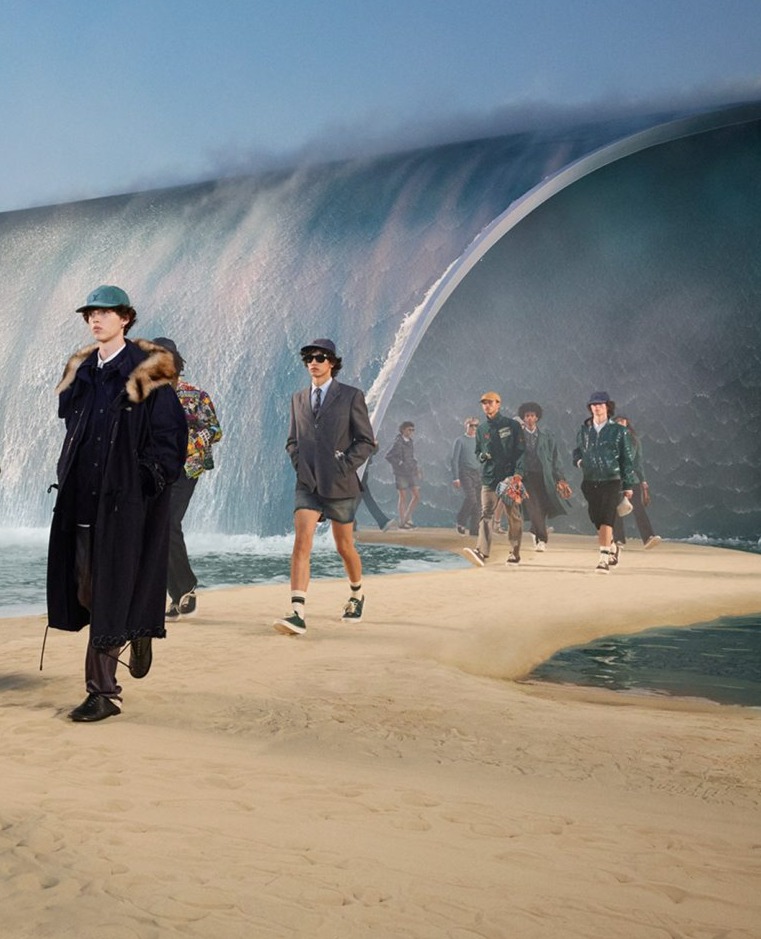
    Louis Vuitton Spring-Summer 2027 show in Paris, 2026. Photo by: Louis Vuitton (https://www.dezeen.com/2026/06/25/jumbo-tidal-wave-louis-vuitton-menswear-show/) 

    Luxury’s Commitment to Sustainability

    Intentionally

    Most luxury brands have adapted to this new standard fairly quickly with their comprehensive sustainability strategies. One of the most prominent examples of sustainability in luxury is Guerlain. With close to 18 years of unrelenting dedication to sustainability, and continuing, Guerlain has consistently taken the initiative to re-evaluate and protect its longstanding foundations.

    Since Guerlain’s brand identity is inspired by bees and its dedication to living nature, the brand has introduced numerous sustainability measures to protect bees and their environment. When it comes to its products – the heart of the brand – Guerlain has built an effective structure to make them as sustainable as possible. Using naturally derived and ethically sourced ingredients, Guerlain’s products are eco-formulated. The products are also designed with refillable options to extend their lifespan. Their packaging now features innovative, eco-friendly materials and construction designed to reduce their carbon footprint. Collectively, these practices contribute to reducing Guerlain’s overall greenhouse gas emissions while minimising the environmental impact of its products throughout their lifecycle. Guerlain also prioritises transparency to allow consumers to better understand the brand’s ethical positioning; therefore, traceability is a core part of their product strategy. Together, these initiatives reflect a sustainability-led product philosophy.

    “At Guerlain, product development is guided by a precise understanding of the impact of each ingredient and component” (2).

    Creatively

    At the same time, sustainability within the luxury framework should not be limited to the production of physical, tangible products. Given the contemporary luxury demographic’s preference for experiences over tangible possessions, sustainability should continue to guide strategic decision-making across the luxury value chain. Therefore, every curated luxury experience should place as much emphasis on sustainable practices as it does on the experience itself. Every component of a luxury experience should be sourced, reused, and disposed of ethically while minimising its environmental impact. 

    The Louis Vuitton Men’s Spring–Summer 2027 show is a compelling example of how luxury can embrace both extravagance and responsible practices without compromising its creativity or impact. Pharrell Williams, Creative Director of Louis Vuitton Menswear, showcased a surf-inspired Spring–Summer 2027 ready-to-wear collection that captivated the fashion community, turning into one of the season’s most talked-about shows. It was not only the actual collection that attracted attention, but also the construction of the runway. A striking wave-like bridge, with cascading blue water and glistening sand carpeting the entire runway, transformed the Cité Internationale Universitaire de Paris into a surfer’s turf. 

    Although the show was widely celebrated, it also raised questions about the extent of the brand’s environmental commitments. As part of LVMH’s Regeneration 2030 roadmap, Louis Vuitton supports Coral Gardeners in advancing reef restoration efforts in French Polynesia, while the show’s water, sourced from Eaux de Paris, will return to the sewer system through a closed circuit, and the sand will be donated to the beach volleyball courts at the Cité Internationale Universitaire de Paris (3). This creative vision by Louis Vuitton exemplified how luxury can be realized responsibly and sustainably without compromise. 

    The Future of Luxury 

    Over the course of time, nature’s own luxuries have contributed immeasurably to countless expressions of luxury. Although the luxury industry has made considerable progress towards more ethical practices, sustainability remains an ongoing challenge. While many brands have embraced greater environmental and social responsibility, lasting change requires a comprehensive approach that integrates sustainability across every aspect of the industry. 

    Therefore, a relentless pursuit of change across the luxury industry, regardless of its initial impact, is essential to preserve and regenerate the natural resources upon which it has long relied. This will enable future generations to continue experiencing and appreciating the same luxuries that define the industry today.


    Sources:

    (1) Håland, W. (1999). On needs — a Central Concept in the Brundtland Report. Towards Sustainable Development, pp.48–69. doi:10.1057/9780230378797_3.

    (2) Guerlain (2024). ACTING FOR LIVING BEAUTY – Sustainable Development Report 2024. [online] Available at: https://www.guerlain.com/on/demandware.static/-/Library-Sites-Guerlain_SharedLibrary/default/vd9a268fd1449769468d4a43e8a3d3e8ea2462b22/pdf/RRSE_guerlain_2025_english%201.pdf?version=1,758,626,467,908&_gl=1*t5pdo5*_gcl_au*MjIwNjI5NDQzLjE3ODMzNjQ1MDE.*FPAU*MTYxNTg0NTU1Mi4xNzgzMzY0NTAx*_ga*MjI2Njg2OTE0LjE3NjkxOTg5ODI.*_ga_TL8PLE0B55*czE3ODMzNjQ1MDAkbzIkZzEkdDE3ODMzNjU3MjAkajQ2JGwwJGgxMjAyMTUzMzkwJGRfV0pKakxtOGxwaUtOWnk5TVprRld1S2dyemNqdXBDTmh3*_fplc*SkV3Y3pSMXhGVVNIcjZOcjhQekdFWnRpYkJxS0RSbiUyQlphVlFLb3Y3cFoxUUVtSGJyNzdVS2g1bW93MSUyQnpqQ3ltc3VPUSUyRmwwTSUyQmFyS2NUSG4xMGRhUjNIMTVONVpUWVdpVFZtdGtTdkFCeHBjNWxHMnRxWUM5VFBpNnFUZ1ElM0QlM0Q.

    (3) LVMH (2025). Louis Vuitton Unveils Its Men’s Spring-Summer 2027 Show – LVMH. [online] LVMH.com. Available at: https://www.lvmh.com/en/news-lvmh/new-wave-at-the-louis-vuitton-spring-summer-2027-mens-show.

  • History of Exceptional Marketing: Why Diamonds Are Still Winning

    History of Exceptional Marketing: Why Diamonds Are Still Winning

    A diamond is not rare. That fact alone could end most conversations about its value, yet it rarely does.

    Diamonds have occupied a central place in Western consumer culture for nearly a century, yet their dominance is difficult to explain through physical properties alone. Other gemstones like sapphires, emeralds, and rubies are much rarer and, in many cases, even more visually striking. What separates diamonds is a narrative constructed and sustained over several decades that had little to do with the stone itself. 

    In the 1930s, De Beers faced a straightforward commercial problem: supply exceeded demand, and the American market showed little appetite for expensive stones during a recession. The company’s response was to commission an advertising campaign that would rebrand diamonds as not just a luxury product but a romantic gesture and a cultural obligation. The result was one of the most studied cases of manufactured cultural norms in marketing history, and it raises a question: how does a commercial product become a social expectation, and what does it take to sustain that position across generations?

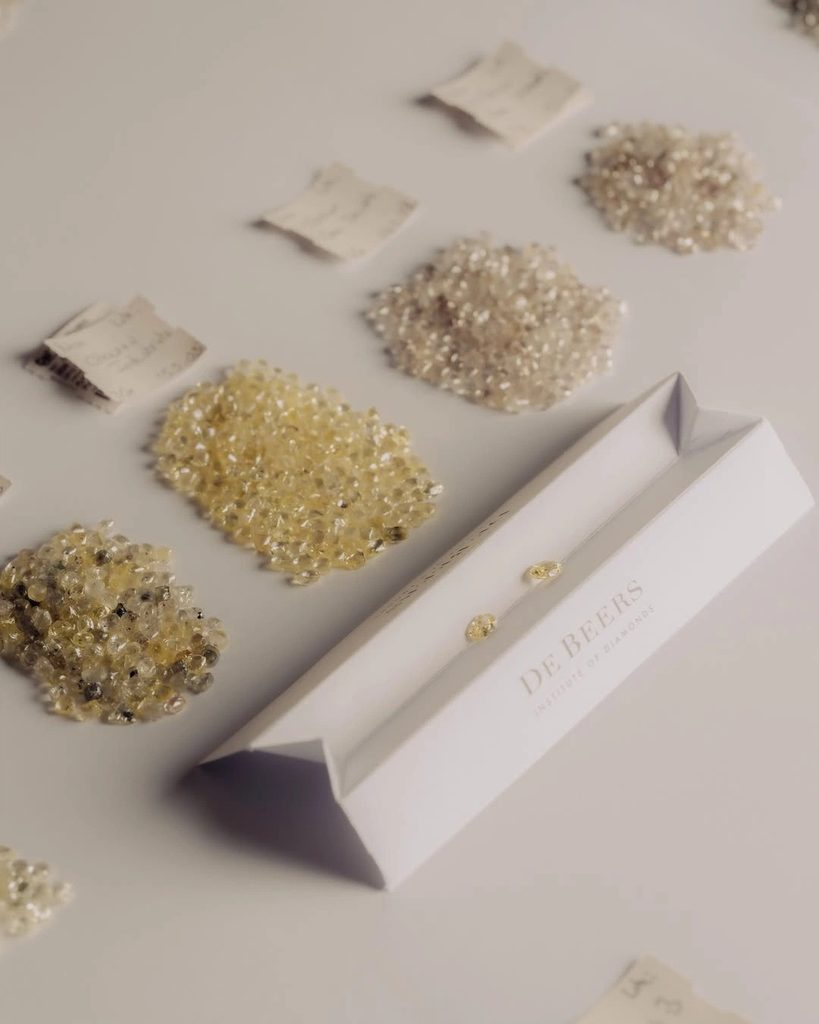
    Diamonds inspected at a De Beers facility in London. Photo by Jack Orton (https://www.cosmos.so/e/1755006488)

    The strategy behind De Beers’ positioning itself as a monopoly lies in its understanding of artificial scarcity. Cecil Rhodes incorporated De Beers Consolidated Mines in 1888 with a clear understanding that diamonds, once discovered in large quantities in South Africa, would lose their value if allowed to flood the market freely. The solution was vertical integration on a scale rarely seen in commodity markets. De Beers moved to control not just mining but distribution, regulating how many stones entered the market at any given time. By the early twentieth century, this system had produced a commodity that behaved unlike any other. 

    At the same time, prices for most raw materials fluctuated with economic cycles. Diamond prices crept steadily upward, decade after decade. Ernest Oppenheimer, who became chairman of De Beers in 1929, inherited this architecture and faced the additional challenge of stimulating consumer demand during the Great Depression. His decision to engage the American advertising agency N.W. Ayer marked the point at which supply control alone gave way to something more ambitious – cultural perception.

    N.W. Ayer produced an advertising campaign that was a coordinated effort to reposition diamonds within American social hierarchy. The agency’s research found that Americans in the late 1930s viewed diamonds as luxuries reserved for the very wealthy, which meant that any straightforward pitch about the quality or beauty of the stones themselves would reach only a narrow audience. Diamonds were placed on the fingers and wrists of film stars and socialites, with 125 newspapers arranged to cover these appearances as fashion rather than promotion. Designers were paid to speak publicly about the trend toward diamonds, and a lecture series on diamonds and engagement was organized across American high schools. Between 1938 and 1941, American diamond sales rose by fifty-five percent, which was enough to confirm the direction but not yet enough to achieve what De Beers actually wanted: a world in which a marriage proposal without a diamond felt incomplete.

    What makes the De Beers case worth examining beyond its commercial dimensions is what it reveals about the durability of manufactured social norms. Lab-grown diamonds are now physically identical to mined stones, certified by the same gemological bodies, and available at a fraction of the price, and yet a significant portion of the market continues to treat them as categorically different.

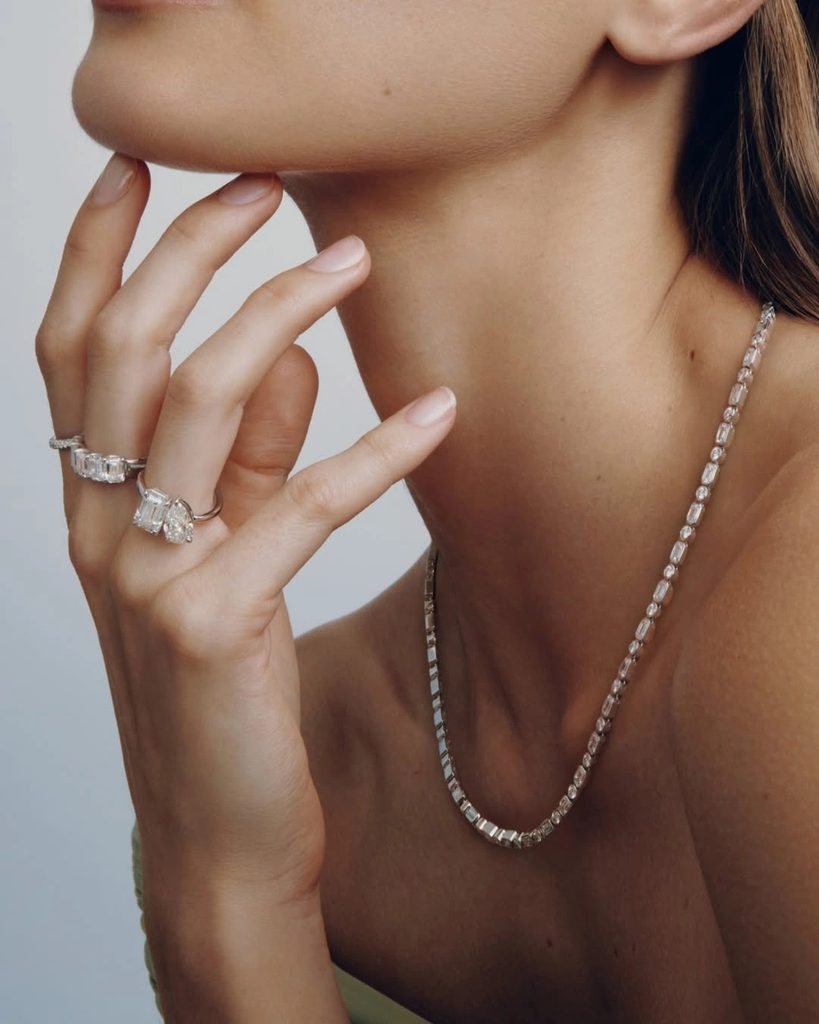
    Model Rachel Fox wears jewelry featuring VRAI-created diamonds, 2024. Photo by: VRAI (https://www.cosmos.so/e/1272103602)

    De Beers itself responded to this by launching Lightbox in 2018, a lab-grown jewelry line positioned explicitly as affordable fashion. The move was designed to preserve the premium perception of natural diamonds by placing synthetic stones in a separate, lower-status category but Lightbox shut down last year, unable to sustain that separation. The fact that this distinction requires active maintenance suggests that the value of a natural diamond was never entirely self-sustaining. It has always depended on a continuous effort to define what a diamond means, who should buy one, and on what occasion. 

    That effort has now been running for nearly ninety years, long enough for the construction to disappear entirely behind what it constructed. A generation that grew up watching their parents exchange diamond rings, that absorbed the idea of a Tiffany solitaire proposal through films, magazine covers, and Instagram announcements, does not experience the diamond as a marketing decision. They experience it as the obvious choice that anyone would make.

    This is the more impressive achievement. De Beers produced a situation in which not buying a diamond requires an explanation. The person who proposes with a sapphire, a moissanite, or nothing at all will spend some portion of their engagement answering questions about it. Remarkable, when you consider that the whole tradition is younger than commercial aviation. 

    The diamond industry succeeded not by making its product indispensable, but by making its absence conspicuous. And that, more than any slogan, is what keeps the market alive.

  • The Voice That Cannot Be Counterfeited

    The Voice That Cannot Be Counterfeited

    How Luxury Brands Build Their Unbreakable Tone of Voice

    If we look at how luxury brands are typically built, the visual system almost always comes first: the monogram, the colour, the silhouette. Language is treated as decoration wrapped around an image that already does the work. Yet if you take away the logo and the product entirely, hand someone a single sentence pulled from a caption or a press release, and a trained eye can still guess the house behind it. That ability is the result of a communication system built with the same rigour as a print, but expressed through vocabulary, rhythm, and syntax rather than fabric and colour.

    This is where most brands stumble. A visual identity can be briefed and produced by an agency in weeks. A voice cannot. It has to behave like a personality rather than a specification; consistent under pressure, and recognisable without a signature (Aaker, 1997). Tone of voice, in this sense, functions less like a style guide and more like a living organism: it adapts to context yet remains unmistakably itself. This matters now more than ever, since AI-generated copy has made competent, on-brief language instantly available to anyone.

    Fashion houses that understand this operate at two extremes of the same discipline. The Row constructs its voice almost entirely through omission, treating silence as authority. Balenciaga does the opposite, building identity through rupture and deliberate discomfort. Both succeed for the same reason: neither can be reverse-engineered from a single post, because both are systems, not styles. This article examines how that system is built, from campaign copy to a practical framework for testing whether a brand’s voice holds up once its name is taken away.

    The Row and Balenciaga: Two Ends of the Same Discipline

    The tone of voice in fashion tends to sit somewhere on a spectrum between whisper and manifesto. At one end, meaning is built through withholding; at the other, through excess. The Row and Balenciaga occupy these opposites almost perfectly, and comparing them shows that a distinctive voice has less to do with volume than with discipline.

    The Row’s communication is built on the scarcity of language itself. The brand rarely issues statements, avoids explanatory captions, and lets garments circulate without narrative scaffolding (FashionUnited, 2025). Even its most viral product moments, such as the Margaux bag, were left to spread through organic conversation rather than brand-authored commentary (FashionUnited, 2025). This is not an absence of strategy but a strategy of absence: every unexplained image asks the audience to supply meaning rather than receive it, which is precisely what makes the brand’s rare public statements carry disproportionate weight.

    Balenciaga’s voice works through the opposite mechanism: rupture. Its campaign language and visual grammar are built to unsettle expectation, using irony, cultural remix, and calculated discomfort to keep the house at the centre of debate (Latterly.org, 2026). Scholars researching the brand’s 2022 crisis describe this as a deliberate register long before it became a liability, noting that shockvertising is designed to be “startling and offensive by intention rather than accident” (The Conversation, 2025). Provocation, in other words, is not a lapse in Balenciaga’s tone. It is the tone.

    What connects these two brands is not proximity in style but consistency in method. Neither voice could survive being copied for a single caption, because neither is really a caption-level choice. Silence reads only as authority when it is sustained everywhere; disruption reads only as intention when it repeats predictably enough to be recognised as a signature rather than an accident. The lesson for any brand watching from the middle of the spectrum is that tone of voice is not about tone at all. It is a rule system, applied without exception.

    Language as a Strategic Asset, Not a Supporting Layer

    Most brand guidelines still treat language as an afterthought, developing it only after the logo, colour palette, and campaign visuals have already been locked. This order of business reflects a widespread assumption in luxury marketing: that words communicate an identity which visuals have already established. Recent research on brand linguistics challenges this assumption directly, arguing that language does not merely describe brand meaning but actively shapes how consumers identify, experience, and evaluate a brand in the first place (Schmitt, 2017).

    This reframing matters because it changes what a copywriter is actually responsible for. Vocabulary, sentence rhythm, and syntax are not stylistic garnish; they are mechanisms that influence recognition and recall in the same way a colour palette does. A brand that consistently favours short, declarative sentences is making a claim about confidence and control, whether or not that claim is stated outright. A brand that writes in long, carefully qualified sentences is making the opposite claim, regardless of what the product itself communicates visually. The discipline that constructs this kind of coherence has existed under its own name for decades: verbal identity, pioneered as a practice distinct from copywriting or advertising language, with its own frameworks, audits, and specialists (Simmons, in Clifton and Blackett, n.d.).

    Once language is understood as a structural layer rather than a decorative one, a further principle follows: what a brand chooses not to say is as strategic as what it says. The Row’s near-total silence and Balenciaga’s constant provocation are not just different amounts of communication; they are different linguistic strategies operating on the same underlying logic, where every word, or the deliberate absence of one, functions as a signal that visual identity alone cannot conceptualise. 

    From Campaign to Caption: Building a Coherent System

    A recognisable voice rarely lives in a single document. It is distributed across dozens of smaller, seemingly minor decisions: the phrasing of a press release, the caption under a runway image, the register of a customer service reply, the syntax of a manifesto posted without further explanation. None of these formats carries the brand’s identity on its own. What creates recognition is the fact that all of them are governed by the same underlying rules, even as their tone shifts from one channel to another.

    This is where the distinction between voice and tone becomes most significant. Voice is the constant: the personality, vocabulary, and syntactic habits that remain stable regardless of context. Tone is the variable: the way the same personality modulates itself depending on the situation, the platform, or the required emotional register. A brand can sound more formal in a press release and more intimate in a caption without contradicting itself, provided the underlying voice, its values, its vocabulary, and its characteristic rhythm stay traceable underneath both. The failure mode is not variation in tone; it is a voice that disappears entirely once the context changes. 

    This coherence is not merely an aesthetic preference. Keller’s foundational model of customer-based brand equity argues that a brand’s equity is built from the associations consumers hold in memory, and that those associations are strengthened or weakened by every marketing interaction they encounter (Keller, 1993). A verbal identity that behaves inconsistently across touchpoints does not simply look sloppy; it actively erodes the distinct, favourable associations that constitute brand equity in the first place. Each inconsistent message competes with, rather than reinforces, everything the audience has already learned to expect. In practice, this means a manifesto, a product description, and a one-line Instagram caption should be treated as expressions of a single grammar rather than three separate writing tasks. The words change. The system producing them should not.

    The Authenticity Test: Can It Be Recognised Without a Name?

    If a brand voice is built rather than merely styled, it should survive a simple test: strip away the logo, the byline, and any visual context, and ask whether the remaining sentence can still be attributed correctly. This is not a hypothetical exercise. It is a method already used in practice: reviewers are given a mix of a brand’s content and its competitors’ with all branding removed, and asked to identify which text belongs to which house (Atom Writer Blog, 2026). A voice that fails this test, one that could have been plausibly written by any competitor in the category, has not actually been thought through. It has only been decorated.

    This framework gives the abstract idea of “tone of voice” something closer to an empirical standard. A genuine verbal identity should be identifiable through vocabulary alone, through characteristic sentence length, through the presence or deliberate absence of certain words, and through rhythm that persists whether the text in question is a manifesto or a two-line caption. Brands whose voice has become genuinely distinctive are already discussed in these terms, described as recognisable in a blind test even without any visual cue attached (Vista Social, 2025). The Row would likely pass this test through restraint alone; a fragment of unexplained, unadorned description would already feel unmistakably its own. Balenciaga would likely pass through friction; a sentence built to unsettle rather than reassure carries its own fingerprint regardless of context.

    What this test ultimately measures is not creativity but discipline. Imitation is easy to produce at the surface level, a wide sentence here, a knowing irony there, but it becomes far harder to sustain the same restraint or rupture across hundreds of unrelated pieces of copy, written under different pressures, for different purposes, over years rather than weeks. A voice that cannot be counterfeited is therefore not the most original one. It is the one applied with enough consistency that imitation collapses under its own inconsistency the moment it is tested at scale.

    Building the System: Where Emerging Brands Should Start

    For a brand without a century of archive behind it, none of this is out of reach; it is simply unbuilt. The starting point is not a tagline or a mood board of adjectives, but an audit of existing language: pull every caption, product description, and email sent in the last six months, and ask which words repeat, which sentence lengths dominate, and whether a stranger could sort them from a competitor’s without seeing the logo. Most young brands discover the answer is no, not because their writing is bad, but because it has never been treated as a system with rules, only as a series of one-off decisions made under a deadline.

    From there, the useful exercise is not reconstructing a voice from scratch but deciding on a clear set of verbal boundaries, since constraints create distinctiveness faster than aspirations do. A brand that commits to never using superlatives, never explaining a reference, or never posting without a verb in the first sentence has already built a stronger voice than one with a thirty-page style guide full of approved adjectives. This is also where a founder’s personal register, if genuine rather than performed, can substitute for the institutional memory a young house lacks. A standardised way of describing a fabric or a process becomes, with enough repetition, as recognisable as an heirloom monogram.

    The final step is treating that voice with the same protectiveness applied to a logo or a print. If a copywriter, an intern, or a generative tool can produce a caption indistinguishable from the brand’s own without reference to a style guide, the guide has failed. Consistency across turnover, across agencies, and across the pressure to sound like whatever performs well that week is what eventually turns a set of preferences into something closer to a personality, and personalities, unlike taglines, are what audiences actually learn to recognise.

    Conclusion

    A logo can be licensed, a colour palette pulled from a Pantone chart, a silhouette reverse-engineered within a season. None of this requires understanding the brand, only observing it. A voice resists this kind of extraction because it is not a surface-level feature. It is what emerges when values and vocabulary are applied across thousands of small decisions that no single competitor ever sees in full. Copying the words without copying the discipline behind them produces only a plausible facade, not the product itself.

    This has particular urgency now. As generative tools make competent, on-brief copy instantly available to anyone, fluency stops being a differentiator. Far fewer brands can sound like themselves under pressure, across every channel, without a name attached. For emerging brands, this is an opening rather than a disadvantage: a voice built with real constraints and enough repetition can pass the same test as a house with a century behind it, because the test was never about age. It was always about discipline.

    The question worth asking of any brand is not whether its voice sounds distinctive in a single campaign, but whether it would still be recognisable with the name removed. That test, more than any style guide, is what separates a voice from an imitation.

    References

    Aaker, J.L. (1997) ‘Dimensions of brand personality’, Journal of Marketing Research, 34(3), pp. 347–356. Available at: https://journals.sagepub.com/doi/10.1177/002224379703400304 .

    Atom Writer Blog (2026) How to measure brand voice consistency: KPIs, scoring, and automated frameworks. Available at: https://www.atomwriter.com/blog/measure-brand-voice-consistency/.

    FashionUnited (2025) The Row and strategic power of silent marketing. Available at: https://fashionunited.com/news/fashion/the-row-and-strategic-power-of-silent-marketing/2025122969797.

    Jones, C.W. (2025) ‘Balenciaga’s controversial new campaign and the long history of “shockvertising”’, The Conversation. Available at: https://theconversation.com/balenciagas-controversial-new-campaign-and-the-long-history-of-shockvertising-195778.

    Keller, K.L. (1993) ‘Conceptualizing, measuring, and managing customer-based brand equity’, Journal of Marketing, 57(1), pp. 1–22.

    Latterly.org (2026) Balenciaga marketing strategy: provocative campaigns, celebrity hype, and virality. Available at: https://www.latterly.org/balenciaga-marketing-strategy/.

    Schmitt, B. (2017) ‘Brand linguistics: A theory-driven framework for the study of language in branding’, Journal of Consumer Psychology, 27(4), pp. 508–531. Available at: https://www.sciencedirect.com/science/article/abs/pii/S0167811617300058 .

    Simmons, J. (n.d.) cited in Clifton, R. and Blackett, T. (eds.) Brands and Branding. Available at: http://www.culturaldiplomacy.org/academy/pdf/research/books/nation_branding/Brands_And_Branding_-_Rita_Clifton_And_John_Simmons.pdf.

    Vista Social (2025) Brand voice guidelines examples: Why consistency matters. Available at: https://vistasocial.com/insights/brand-voice-guidelines-examples/.

  • Luxury, an ID

    Luxury, an ID

    How Consumers Use Luxury As An Identity Verifier 

    As humans, we place significant value on two of the most basic aspects of social life: our identity and our desire to associate with others. Across generations, self-recognition and social connections have influenced an individual’s quality of life, both directly and indirectly. In a contemporary society, where personal expression and memorable experiences are increasingly favoured, the desire for community and belonging has become more pronounced than ever.

    Identity is often communicated through an intentionally curated combination of values, culture, knowledge, and personal preferences. An individual’s self-perception influences how they present themselves and the people they value as connections. One of the most powerful languages through which one can communicate their sense of self and societal positioning is luxury. With that said, how exactly does one translate luxury into identity? 

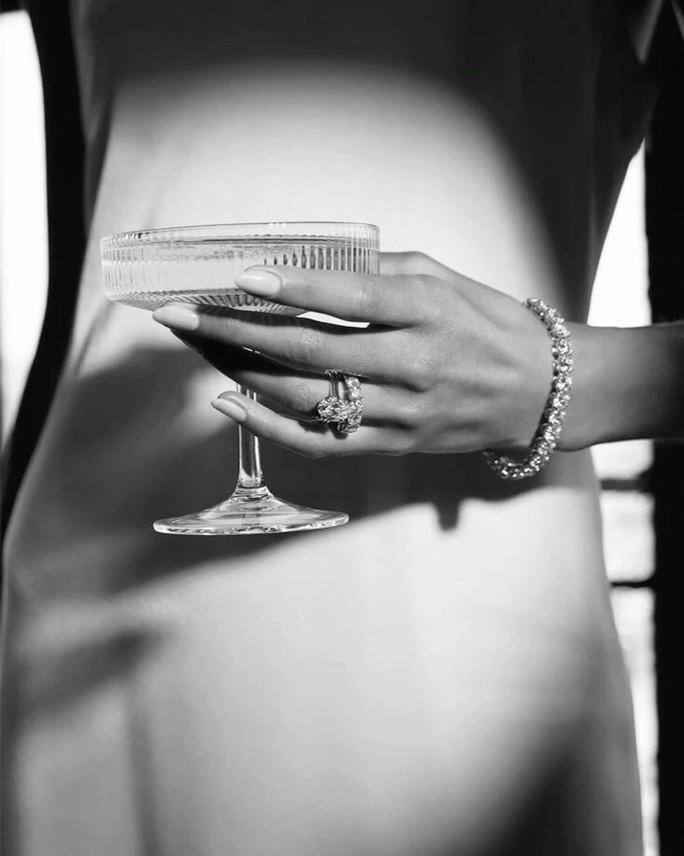
    A photograph from Tempus Jewellery featuring a diamond ring and tennis bracelet. https://www.cosmos.so/e/1689622486 

    Luxury As Identity

    When luxury is expressed as a primary form of self-expression, it signals a distinct standard of expectation, from both oneself and society. More often than not, luxury signifies a sophisticated lifestyle, embraced by those who value a highly selective and personalized way of life. However, it is not mere access that validates an individual’s position within luxury, but rather the manner in which they engage with luxury itself.

    This reframes luxury as less about possession and more about articulation as an external expression of internal identity. It allows an individual to translate abstract elements of the self – taste, aspiration, values, and personal recognition – as visible and socially legible forms of expression, making identity both observable and socially interpretable.

    Identity in Luxury

    Luxury was initially associated with hedonistic consumers who had positioned luxury as a signifier of their immense wealth and social standing. Their indulgences in luxury were perceived as investments that sustained their status and lifestyle. At the time, opulence was what defined their identities and influenced their social ties. An individual’s self-expression was centred around extravagant adornments and statement pieces that were designed to mirror their wealth. However, the perception of luxury has since expanded. In the contemporary context, luxury has increasingly become centred on emotional values and social representations that now reflect an individual’s identity and associations. Every interaction with luxury is refined to represent who an individual is and what they embody. Importantly, luxury operates on both self-directed and externally projected identity. It is how an individual can simultaneously construct their own sense of self, and how that self is interpreted, validated, or repositioned within the perception of others.

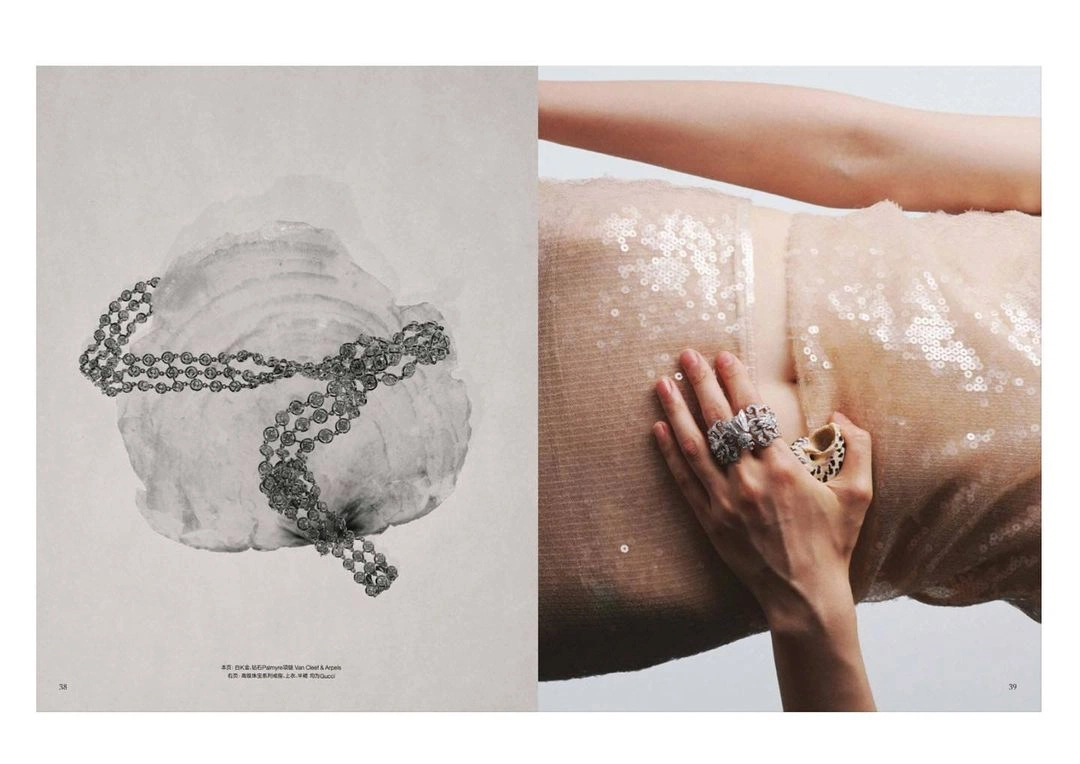
    Photo by Kosmas Pavlos for The Glass Magazine (https://www.cosmos.so/e/996799830)

    Identification with Luxury

    The foundational concept of luxury is intentionality. It is the consideration behind each aspect, from the pre- to post- experience, that makes luxury truly luxurious. In a day and age where self-expression is loud but emotional resonance is louder, individuals often engage with experiences that reflect their voices or embody their values. Therefore, the potential of any interaction by an individual is measured against a personal value scale, with a primary focus on “What will this make me feel?” and “Who can I share it with?”.

    An individual whose identity and social connections are built upon luxury fashion would not continuously engage with every available fashion house, but rather reserve their loyalty for the brands that best reflect and respect their identity. Luxury is therefore experienced through carefully selected fashion houses that publicly uphold a similar ethos. For instance, choosing to stand with a fashion house such as Dior is also a choice to align with the values of its savoir-faire. From quality and craftsmanship to sustainability and cultural positioning, each aspect identifies with both the individual and the fashion house. Here, an individual does not engage with the brand solely as a client but as a contributor in a broader narrative. This places both the individual and the house on each other’s radar of shared identities, which over time builds connections, recognition, and affiliation. This level of intentionality creates a reciprocal sense of identity among the individual, the brand, and the broader society they seek recognition within.

    Luxury, the ID

    At its core, luxury operates as a mechanism through which identity is not only expressed but also reinforced through recognition. It has become a space where self-expression and social belonging come together, allowing individuals to situate themselves within a collective of shared values and perspectives. In this sense, luxury extends beyond tangible possessions and acts as a social language that continuously authorizes recognition between the individual and society. Luxury has now become a salient system of identification to recognise how an individual perceives themselves, how they want to be perceived, and the communities they identify with. Through the dynamic relationship between identity and recognition, luxury has become a central framework of self-definition, one that validates belonging while simultaneously distinguishing individuality within a shared cultural space.