
How Luxury Learned to Monetise the Scarcity Mindset
For most of its history, the luxury industry sold objects whose rarity could be traced back to something physical. A Kashmir sapphire is rare because the mines above Padar were largely depleted by the 1930s. A Patek Philippe minute repeater is rare because the number of people capable of tuning its gongs is limited and shrinking. Hermès trains a leather artisan for two years before that person is allowed to finish a bag independently , and the output level of a workshop is limited by the number of employees inside it. In each case, the scarcity exists outside the brand’s marketing department. A buyer paying for rarity was paying for a shortage that existed whether or not anyone was looking.
The economics of such a business model stopped matching the size of the industry sometime in the last two decades. The large conglomerates now report revenues in the tens of billions of euros, and speak to audiences measured in the hundreds of millions on Instagram. Hermès produces more Birkins today than it did ten years ago, and the waiting times have not shortened. The concept of scarcity in luxury lives on, but it has moved from production limitations to being the heart of the new distribution model. The shortage an individual client experiences is increasingly a shortage of permission to consume rather than a shortage of goods and services, which changes how the act of buying feels. The question shifts from whether an object is rare to whether the opportunity to acquire it will still exist next season.

Jewelry by Fernando Jorge at his New York showroom, designed by Andre Mellone. Photo by: Billal Baruk Taright (https://www.cosmos.so/e/797450311)
The waitlist is the oldest of these instruments and the least honest about what it truly is. Hermès has never admitted to the existence of a formal Birkin list, which is true in some sense, because it is instead a purchase history a sales associate reads before deciding what to offer. Ferrari makes the logic explicit: access to a limited series such as the LaFerrari Aperta was restricted to collectors with an existing ownership record. The wait is not a delay in the transaction. It is part of the buying decision, because the time spent qualifying becomes evidence that the object was difficult to obtain, whilst allowing time to personalise the sale for the customers that do qualify.
This limited-edition drop delivers the same concept in a much tighter window. A product exists for a defined timeline, and the decision to buy is made under time pressure rather than after proper reflection. When Patek Philippe discontinued the Nautilus 5711 in 2021 and released a final green-dial run, resale prices on the secondary market climbed to several times the original retail price almost immediately, with no change to the watch itself. The sold-out label completes the picture. Absence communicates more powerfully than availability, and a brand that sells out quickly has demonstrated demand in a way no campaign can.
The invitation is arguably the most valuable of these tools because it cannot be acquired directly. Private salons above the boutiques on Place Vendôme, high jewellery previews held during couture week, dinners attached to a fair, first access to a collection before it is catalogued: none of these appear in a product assortment. They are distributed on the basis of the client-brand relationship, and the client who receives one has been evaluated and chosen rather than served.
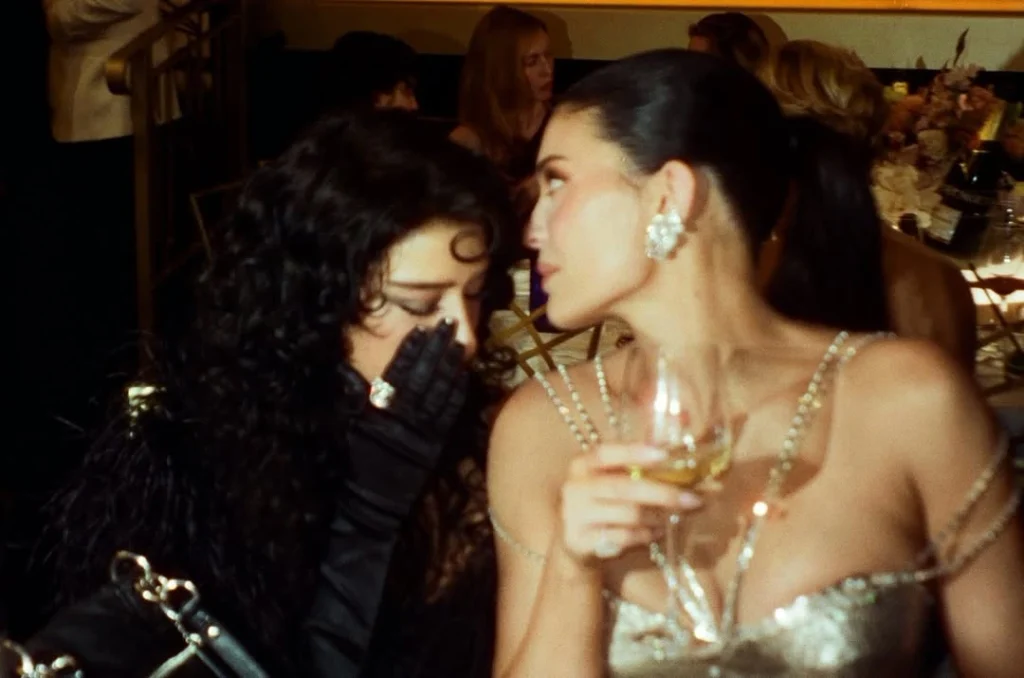
Kylie Jenner and Odessa A’zion at the 83rd Annual Golden Globe Awards. Photo by: German Larkin (https://www.cosmos.so/e/145211867)
A collector who was not invited to a dinner in Geneva would most likely never learn the dinner had taken place, and the social cost of exclusion used to be low because exclusion was invisible. Instagram removed that confinement, and now the guest list, the table, the pieces shown, and the people shown in them circulate publicly within minutes. The effect is asymmetric: the number of people who see an event has grown by several orders of magnitude while the number of people admitted has stayed constant or fallen. Visibility, which the industry pursued as a growth strategy, turned out to be the mechanism that takes away accessibility.
The limit of the model is that engineered scarcity depends on whether it is believed. When every capsule is limited, every dinner is private, and every release is a limited edition, it loses its information value, and clients begin to read the mechanism rather than the object. Scarcity fatigue is difficult to measure from the inside, because the queue is still there and the product still sells out.
Leave a Reply