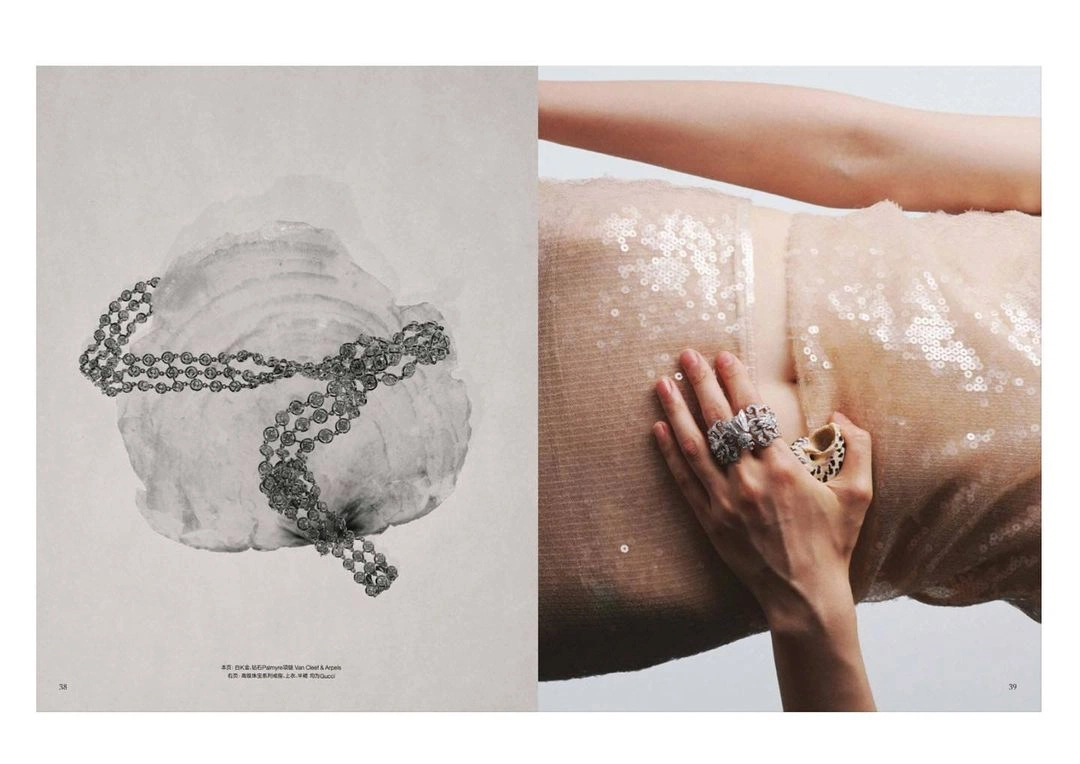
A diamond is not rare. That fact alone could end most conversations about its value, yet it rarely does.
Diamonds have occupied a central place in Western consumer culture for nearly a century, yet their dominance is difficult to explain through physical properties alone. Other gemstones like sapphires, emeralds, and rubies are much rarer and, in many cases, even more visually striking. What separates diamonds is a narrative constructed and sustained over several decades that had little to do with the stone itself.
In the 1930s, De Beers faced a straightforward commercial problem: supply exceeded demand, and the American market showed little appetite for expensive stones during a recession. The company’s response was to commission an advertising campaign that would rebrand diamonds as not just a luxury product but a romantic gesture and a cultural obligation. The result was one of the most studied cases of manufactured cultural norms in marketing history, and it raises a question: how does a commercial product become a social expectation, and what does it take to sustain that position across generations?

Diamonds inspected at a De Beers facility in London. Photo by Jack Orton (https://www.cosmos.so/e/1755006488)
The strategy behind De Beers’ positioning itself as a monopoly lies in its understanding of artificial scarcity. Cecil Rhodes incorporated De Beers Consolidated Mines in 1888 with a clear understanding that diamonds, once discovered in large quantities in South Africa, would lose their value if allowed to flood the market freely. The solution was vertical integration on a scale rarely seen in commodity markets. De Beers moved to control not just mining but distribution, regulating how many stones entered the market at any given time. By the early twentieth century, this system had produced a commodity that behaved unlike any other.
At the same time, prices for most raw materials fluctuated with economic cycles. Diamond prices crept steadily upward, decade after decade. Ernest Oppenheimer, who became chairman of De Beers in 1929, inherited this architecture and faced the additional challenge of stimulating consumer demand during the Great Depression. His decision to engage the American advertising agency N.W. Ayer marked the point at which supply control alone gave way to something more ambitious – cultural perception.
N.W. Ayer produced an advertising campaign that was a coordinated effort to reposition diamonds within American social hierarchy. The agency’s research found that Americans in the late 1930s viewed diamonds as luxuries reserved for the very wealthy, which meant that any straightforward pitch about the quality or beauty of the stones themselves would reach only a narrow audience. Diamonds were placed on the fingers and wrists of film stars and socialites, with 125 newspapers arranged to cover these appearances as fashion rather than promotion. Designers were paid to speak publicly about the trend toward diamonds, and a lecture series on diamonds and engagement was organized across American high schools. Between 1938 and 1941, American diamond sales rose by fifty-five percent, which was enough to confirm the direction but not yet enough to achieve what De Beers actually wanted: a world in which a marriage proposal without a diamond felt incomplete.
What makes the De Beers case worth examining beyond its commercial dimensions is what it reveals about the durability of manufactured social norms. Lab-grown diamonds are now physically identical to mined stones, certified by the same gemological bodies, and available at a fraction of the price, and yet a significant portion of the market continues to treat them as categorically different.
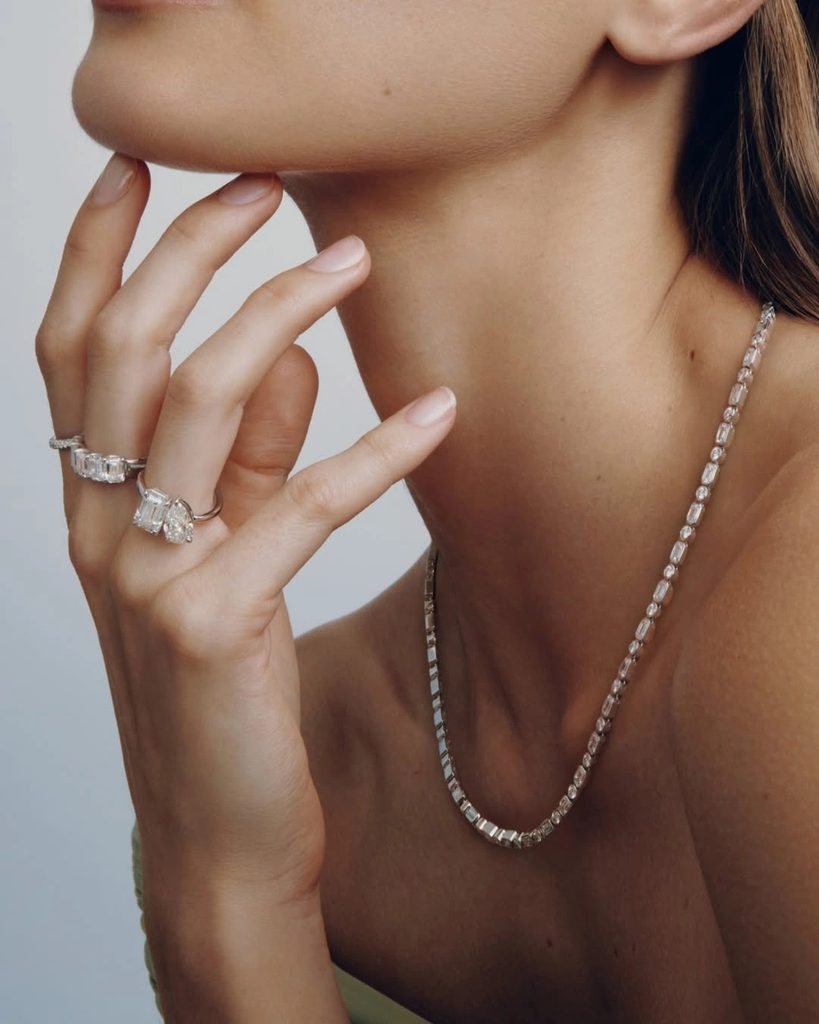
Model Rachel Fox wears jewelry featuring VRAI-created diamonds, 2024. Photo by: VRAI (https://www.cosmos.so/e/1272103602)
De Beers itself responded to this by launching Lightbox in 2018, a lab-grown jewelry line positioned explicitly as affordable fashion. The move was designed to preserve the premium perception of natural diamonds by placing synthetic stones in a separate, lower-status category but Lightbox shut down last year, unable to sustain that separation. The fact that this distinction requires active maintenance suggests that the value of a natural diamond was never entirely self-sustaining. It has always depended on a continuous effort to define what a diamond means, who should buy one, and on what occasion.
That effort has now been running for nearly ninety years, long enough for the construction to disappear entirely behind what it constructed. A generation that grew up watching their parents exchange diamond rings, that absorbed the idea of a Tiffany solitaire proposal through films, magazine covers, and Instagram announcements, does not experience the diamond as a marketing decision. They experience it as the obvious choice that anyone would make.
This is the more impressive achievement. De Beers produced a situation in which not buying a diamond requires an explanation. The person who proposes with a sapphire, a moissanite, or nothing at all will spend some portion of their engagement answering questions about it. Remarkable, when you consider that the whole tradition is younger than commercial aviation.
The diamond industry succeeded not by making its product indispensable, but by making its absence conspicuous. And that, more than any slogan, is what keeps the market alive.
Leave a Reply