Luxury has always adapted to the way wealth moves.
Credit cards once seemed unconventional for high-value purchases. International bank transfers transformed global commerce. Today, another shift is underway, one that many luxury entrepreneurs are only beginning to notice.
Stablecoins, digital currencies linked to traditional currencies such as the US dollar or euro, are quietly becoming part of the financial infrastructure behind luxury transactions. While headlines often focus on cryptocurrency speculation, the more interesting story is how affluent consumers and businesses are choosing to pay.
For founders building luxury brands today, understanding this trend is becoming less about technology and more about customer experience.
Beyond Bitcoin
When many people hear “crypto,” they think of Bitcoin’s price swings and market volatility.
Stablecoins are something different.
A stablecoin is a digital currency designed to maintain a fixed value, typically one US dollar or one euro. The most widely used examples, USDC and USDT, combine the speed and global reach of blockchain networks with the predictability of traditional money.
In practical terms, they allow funds to move internationally within minutes, twenty-four hours a day, without relying on multiple intermediary banks.
For a luxury business with clients in Dubai, Singapore, New York, Monaco, or London, that creates possibilities that traditional payment infrastructure often struggles to match.
Luxury is Already Using Them
The adoption of stablecoins in luxury is not a future prediction. It is already happening.
Real estate has emerged as one of the most active sectors. Across Dubai, developers such as Emaar, DAMAC, Sobha, Nakheel, and Ellington have embraced digital asset payments for both completed and off-plan properties. For international buyers, particularly those already holding digital assets, the ability to complete large transactions quickly and efficiently has become increasingly attractive.
The automotive sector has followed a similar path. Ferrari introduced cryptocurrency payments in North America before expanding into Europe, while a growing number of Lamborghini, Bentley, Rolls-Royce, and Bugatti dealerships now facilitate transactions using digital assets through regulated payment partners.
Yachts and private aviation were perhaps inevitable candidates. These industries have always catered to globally mobile clients who value convenience and speed. Several major yacht brokers and private jet operators now accept stablecoin payments for purchases and charter services, with transactions ranging from six figures to several million dollars.
The art world, often an early adopter of new forms of wealth, has also embraced the trend. Major auction houses now regularly facilitate purchases using digital assets, particularly among younger collectors and technology entrepreneurs.
Luxury hospitality, fashion, private aviation, art, and yachting have all embraced digital asset payments in recent years. Select hotels, resorts, galleries, yacht brokers, private jet operators, department stores, and flagship retail locations now allow customers to pay using digital currencies while merchants continue receiving traditional currency in their accounts.
Well-known luxury brands have already embraced this shift. Ferrari accepts crypto payments in several markets, Aeroaffaires offers stablecoin payments for private jet charters, Maddox Gallery facilitates artwork purchases using digital assets, and Yacht Hub Group enables clients to pay for yacht sales and charters with cryptocurrency.
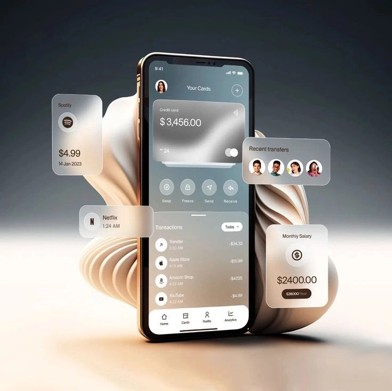
A mobile banking UI/UX concept with a glassmorphism style, created by Praan Studio (https://www.cosmos.so/e/837821583 )
What This Means for Young Luxury Brands
For entrepreneurs in the early stages of building a luxury business, the question is not whether every customer wants to pay with stablecoins.
Most do not.
The more important question is whether some of your most valuable future customers will.
Many luxury startups spend years refining packaging, customer service, showroom design, and digital experiences. Payments are often treated as an afterthought. Yet for international clients making significant purchases, the payment experience can become a surprisingly important part of the overall brand experience.
A buyer willing to spend €50,000 on a watch collection or €500,000 on a property investment generally expects the transaction process to be smooth. Any unnecessary friction can feel out of place. After all, luxury is fundamentally about convenience, efficiency, and removing obstacles. Clients who are accustomed to concierge services, private travel, and personalised experiences rarely expect the final stage of a transaction to involve lengthy banking delays, multiple intermediaries, or avoidable administrative hurdles.
The Good News: You Do Not Need To Become a Crypto Company
One of the biggest misconceptions is that accepting stablecoin payments means holding cryptocurrency on a company’s balance sheet.
In most cases, it does not.
Modern payment providers can receive a customer’s stablecoin payment, convert it instantly into euros, dollars, or pounds, and deposit the funds into a traditional business bank account. The merchant never needs to manage wallets, trading platforms, or cryptocurrency custody.
From an operational perspective, the process often feels closer to receiving a bank transfer than participating in the crypto economy.
This distinction matters because it shifts the conversation away from speculation and toward customer convenience.

Photo by Karolina Grabowska (https://www.cosmos.so/e/969072838)
Why Demand is Growing
Part of the answer lies in how wealth is changing.
A growing share of high-net-worth individuals now hold digital assets as part of their broader portfolios. Many founders, investors, and entrepreneurs who generated wealth through technology, venture capital, or crypto-native businesses are accustomed to managing significant portions of their liquidity digitally.
There is also a less discussed but equally important reason. In many parts of the world, local currencies have experienced significant depreciation over the past decade. As a result, businesses and individuals increasingly use US dollar-backed stablecoins as a way to preserve purchasing power and store value. In markets across Latin America, Africa, Eastern Europe, and parts of Asia, stablecoins have become a practical financial tool rather than a speculative investment.
For luxury brands serving international clients, this matters. A customer may hold substantial wealth in stablecoins not because they are a crypto enthusiast, but because it has become one of the most efficient ways to hold and move dollars internationally.
There is also a generational factor at play. The next generation of luxury buyers grew up with smartphones, digital banking, and global online commerce. They are comfortable moving capital digitally and often expect the same level of convenience from luxury brands that they receive from modern financial services.
For them, payment flexibility increasingly signals that a business understands how contemporary wealth works.
Looking Ahead
The infrastructure supporting stablecoins is maturing rapidly.
Regulation is becoming clearer. Financial institutions are becoming more involved. Large payment networks are investing heavily in digital settlement systems. Real estate, collectibles, and other assets are beginning to be represented digitally on blockchain networks.
None of this means traditional banking will disappear. Far from it.
What it does suggest is that businesses will gradually gain more options for how they receive and move money internationally.
For luxury entrepreneurs, the takeaway is simple.
You do not need to become an expert in blockchain technology. You do not need to follow cryptocurrency markets every day. But understanding how affluent customers increasingly transact is becoming part of understanding modern luxury itself.
The most successful luxury brands have always paid attention to emerging shifts in customer behaviour before they became mainstream.
Stablecoins may prove to be another example.
Not a revolution that arrives with fanfare, but a quiet change that, over time, becomes difficult to imagine doing business without.
Leave a Reply