
For most contemporary brands, going viral is the ultimate goal. But for luxury, mass exposure can threaten the exclusivity and mystique that traditionally fueled desire. Yet social media has made mass attention almost indistinguishable from cultural relevance, leaving luxury brands with a more complicated question: how do you become part of the conversation without becoming too familiar? (Creevey, Coughlan and O’Connor, 2022).
The distinction between visibility and desirability is important because visibility alone does not create desire. Research on luxury brand growth has found that awareness can increase desirability, while excessive market penetration can weaken it (Kapferer and Valette-Florence, 2018). Therefore, a viral moment can be seen by millions and still do very little for the brand behind it. What matters is the feeling that kind of attention triggers in viewers: curiosity, aspiration, proximity, or the sense that they are looking at something they want to be part of.
This is where the idea of the viral moment becomes increasingly viable for luxury. The strongest examples are rarely about simply putting a product in front of as many people as possible. They create something people want to talk about: an unexpected collaboration, an installation worth photographing, an invitation that cannot be easily obtained, or a detail that leaves just enough unanswered. The moment spreads, but the feeling of access remains selective.
For luxury startups, the challenge is not to choose between attention and exclusivity. It is to design moments where one creates the other.

A behind-the-scenes look at a photoshoot for the collection THE DROP. Photo by: THE DROP Staff (https://www.cosmos.so/e/649921880)
Why Traditional Virality Conflicts With Luxury Positioning
Traditional viral marketing is built around removing barriers. The easier something is to see, understand, reproduce, and share, the further it can travel. Luxury has historically created desire through a different set of signals: rarity, selectivity, and the feeling that access is not equally available to everyone. Social media brings these two systems into direct contact, giving consumers more power to create and distribute brand-related content while making exclusivity harder to control (Creevey, Coughlan and O’Connor, 2022).
The tension, however, is not simply between being visible and being exclusive. Research on 60 major luxury brands across six countries found that awareness consistently increases desirability, while greater brand penetration can have the opposite effect (Kapferer and Valette-Florence, 2018). In other words, luxury does not need less attention. In other words, the challenge is not to limit attention, but to ensure that greater visibility does not come at the expense of desirability.
This makes the mechanics of virality particularly impactful. A moment that reaches millions can strengthen a brand by giving those audiences something distinctive to recognise and desire. But simply adding restrictions or making content harder to access is not enough. Recent research about scarcity-based communication on Instagram found that scarcity can reduce perceived exclusivity when it fails to generate consumer interest, with brand familiarity influencing the effect (Godey et al., 2025).
The real question, then, lies in the gap between reach and desire. A successful viral moment for luxury should not be hidden from the majority. It has to give people a reason to care about seeing it, talking about it, or being close to it, while preserving a sense of access and experience that social media alone cannot provide.
Visibility Is Not Desirability
A million views tell a brand how far a moment travelled. They do not reveal what the audience wanted from it. In luxury, that distinction is exceptionally crucial: consumers engage with brands not only because they recognise them, but because the content reflects how they see themselves: through aesthetics, entertainment, self-expression, or status (Bazi, Filieri and Gorton, 2020).
This changes the role of the audience. The person sharing a luxury moment is not simply distributing the brand’s message; they are equating it to their own identity. Research on luxury social media engagement has found that brand self-expressiveness is a significant driver of engagement, which can in turn strengthen brand image and loyalty (Gummerus et al., 2020). The most valuable interaction is not necessarily the one that generates another impression; it is the one that allows the person sharing it to express themselves.
This also explains why a highly visible moment can still feel strangely empty. If the audience has nothing to gain beyond having seen it, there is little reason for the moment to travel further. The strongest luxury content gives people something to signal: taste, cultural awareness, proximity, or simply the fact that they noticed something before it became familiar. Recent research similarly finds that digital word-of-mouth can support luxury brand equity while remaining compatible with an exclusivity positioning (Casais et al., 2025)
The measure of a successful viral moment, therefore, is not only how many people saw it. It is whether they left wanting something that interaction could not provide: the product, the experience, the access, or the feeling of belonging to the world around the brand.
Talkability Without Becoming Mainstream
The most impactful luxury moments are rarely the ones that explain themselves. They leave something for the audience to capture, interpret, speculate about, or pass between people. That unfinished quality gives a brand conversation a life beyond the original campaign.
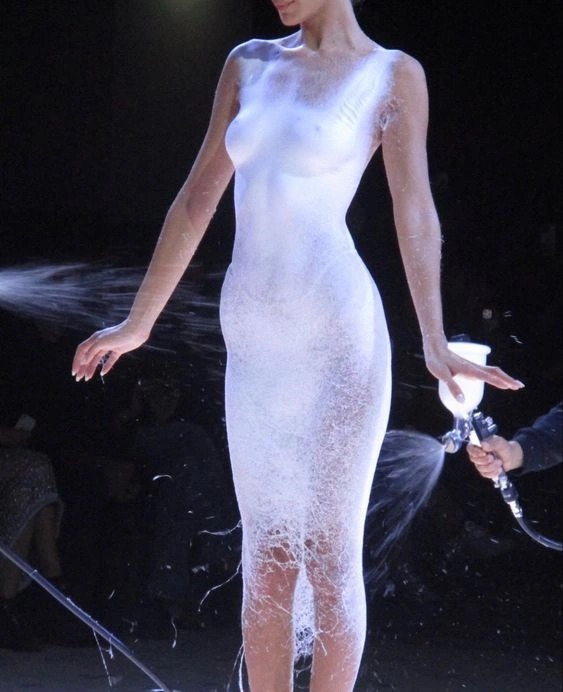
Model Bella Hadid wears a spray-on dress from Coperni’s Spring 2023 show at Paris Fashion Week. (https://www.cosmos.so/e/1401601474)
Coperni’s 2022 spray-on dress is a useful example. During its Spring/Summer 2023 show, Bella Hadid walked onto the runway in underwear before scientists sprayed a liquid directly onto her body, turning it into a fitted white dress in minutes. Coperni’s 2022 spray-on dress is a useful example. During its Spring/Summer 2023 show, Bella Hadid walked onto the runway in underwear before scientists sprayed a liquid directly onto her body, turning it into a fitted white dress in minutes. The technology was real, but the spectacle was almost theatrical: it was less a product demonstration than a moment designed to be witnessed. Within 48 hours, the activation generated an estimated $26.3 million in media impact value, while Coperni’s Instagram following jumped from 315,000 to 552,000 (Maguire, 2022).
What made the moment travel was not simply novelty. It gave people something to talk about beyond the clothes themselves: how the material worked, whether it could become a real garment, and what they had just watched unfold on the runway.
That level of recognition creates a different kind of visibility, one where the brand becomes part of the conversation rather than simply being seen. The brand did not make every part of the experience readily accessible; it created an event that could be endlessly reproduced through images and video while remaining impossible to experience in exactly the same way. The original moment belonged to the runway. Everything that followed was its echo.
For a luxury startup, this distinction matters. The objective is not simply to give people something to share. It is to create a moment, the meaningfulness of which expands as it travels, without making the brand itself feel ordinary.
Designing Moments People Want to Share
True shareability occurs when an experience shifts from passive viewing to active participation. Research into engagement with social media accounts of luxury brands points to several recurring drivers, including entertainment, aesthetics, authenticity, inspiration and social status (Bazi, Filieri and Gorton, 2020). The implication is simple: the product does not have to be the entire story. Sometimes, the experience surrounding it is what makes people want to pass it on.
This is where the design of the moment matters. The strongest activations usually contain something immediately recognisable, something unexpected, and something that rewards a second look. This is where the design of the moment matters. The strongest activations usually contain something immediately recognisable, something unexpected, and something that rewards a second look. They should be immediately understandable, while still leaving enough ambiguity to reward a second look. That tension gives the audience a reason to pause before giving them a reason to share.
Gentle Monster has built much of its retail strategy around this principle. Its stores are designed less as conventional points of sale than as immersive environments, filled with oversized sculptures, moving figures, and surreal installations. The products remain present, but the store itself becomes the destination. The experience is therefore easy to photograph and circulate without reducing the brand to a single product image (Kim, 2023).
This lesson is especially relevant for startups. A shareable moment does not necessarily require a large budget or an elaborate production. It needs a clear idea that can be understood instantly and remembered afterwards. The strongest moments give people an image, an emotion, or a story they can carry elsewhere, while keeping enough of the brand’s world intact for the audience to be able to spot and recognise where it came from.
In luxury, the most effective viral moment is therefore not the one that asks to be shared. It is the one that makes sharing feel like part of the experience.
From Viral Moment to Brand Desire
A viral moment can put a brand into the conversation. It cannot, on its own, give that conversation meaning. For a luxury startup, the real test comes after the attention: does the moment make the brand more recognisable, more culturally relevant, or more desirable?
This is where consistency becomes integral. The most effective moments are not isolated acts of spectacle; they feel like extensions of a world the brand has already been building. Coperni’s sense of technology and experimentation made its spray-on dress feel like more than a stunt. Gentle Monster’s surreal retail environments work for the same reason: the spectacle is not separate from the brand, but an expression of how it wants to be experienced.
The distinction is easy to miss. A brand can engineer an enormous spike in attention and still leave consumers with nothing to remember beyond the event itself. Luxury startups lack room for that disconnection because they are often still teaching the market what the brand stands for. Every highly visible moment therefore does two jobs at once: it attracts attention and defines the brand.
The value of a viral moment therefore lies not only in the attention it generates, but in its ability to strengthen the associations consumers form with the brand.
Conclusion
For luxury startups, the goal is not to avoid mass attention, but to control what that attention communicates. A viral moment is valuable when it creates recognition without exhausting the sense of discovery that makes a brand desirable.
This will become more difficult as social platforms become increasingly crowded and AI makes the production of attention-grabbing content faster and cheaper. The advantage will therefore shift from simply creating something visually striking to creating moments that are difficult to replicate because they are rooted in a distinctive product, place, experience, or brand idea. For emerging luxury brands, virality will matter less as a measure of how many people saw them and more as a test of whether people remember what made them different.
References
- Bazi, S., Filieri, R. and Gorton, M. (2020) ‘Customers’ Motivation to Engage with Luxury Brands on Social Media’, Journal of Business Research, 112, pp. 223–235.
https://doi.org/10.1016/j.jbusres.2020.02.032 - Casais, B., Soares, A.M., Abreu, M., Lungu, D. and Rodrigues, J. (2025) ‘“Look at What I Own”: The Role of Social Media in Luxury Brand Equity and Conspicuous Consumption’, Asia Pacific Journal of Marketing and Logistics, 38(7), pp. 2035–2050.
https://doi.org/10.1108/APJML-03-2025-0403 - Creevey, D., Coughlan, J. and O’Connor, C. (2022) ‘Social Media and Luxury: A Systematic Literature Review’, International Journal of Management Reviews, 24(1), pp. 99–129.
https://doi.org/10.1111/ijmr.12271 - Kapferer, J.-N. and Valette-Florence, P. (2018) ‘The Impact of Brand Penetration and Awareness on Luxury Brand Desirability: A Cross Country Analysis of the Relevance of the Rarity Principle’, Journal of Business Research, 83, pp. 38–50.
https://doi.org/10.1016/j.jbusres.2017.09.025 - Lim, H., Childs, M., Cuevas, L. and Lyu, J. (2021) ‘Between You and Me: The Effects of Content Ephemerality and the Role of Social Value Orientation in Luxury Brands’ Social Media Communication’, Journal of Global Fashion Marketing, 12(2), pp. 120–132.
https://doi.org/10.1080/20932685.2021.1881579 - Maguire, L. (2022) ‘A Spray-On Dress and a Solid Gold Bag: Coperni Goes After Gen Z With Novelty and Fun’, Vogue Business, 1 October.
Vogue Business article - Nechaeva, O., Dasmia, C., Mazzoli, V., Vannucci, V. and Donvito, R. (2025) ‘Scarcity in Luxury Brand Digital Communication: Unveiling Its Effect on Consumer Perceptions’, International Journal of Advertising, 44(7), pp. 1195–1226.
https://doi.org/10.1080/02650487.2024.2427516 - Oliveira, M. and Fernandes, T. (2022) ‘Luxury Brands and Social Media: Drivers and Outcomes of Consumer Engagement on Instagram’, Journal of Strategic Marketing, 30(4), pp. 389–407.
https://doi.org/10.1080/0965254X.2020.1777459
Leave a Reply