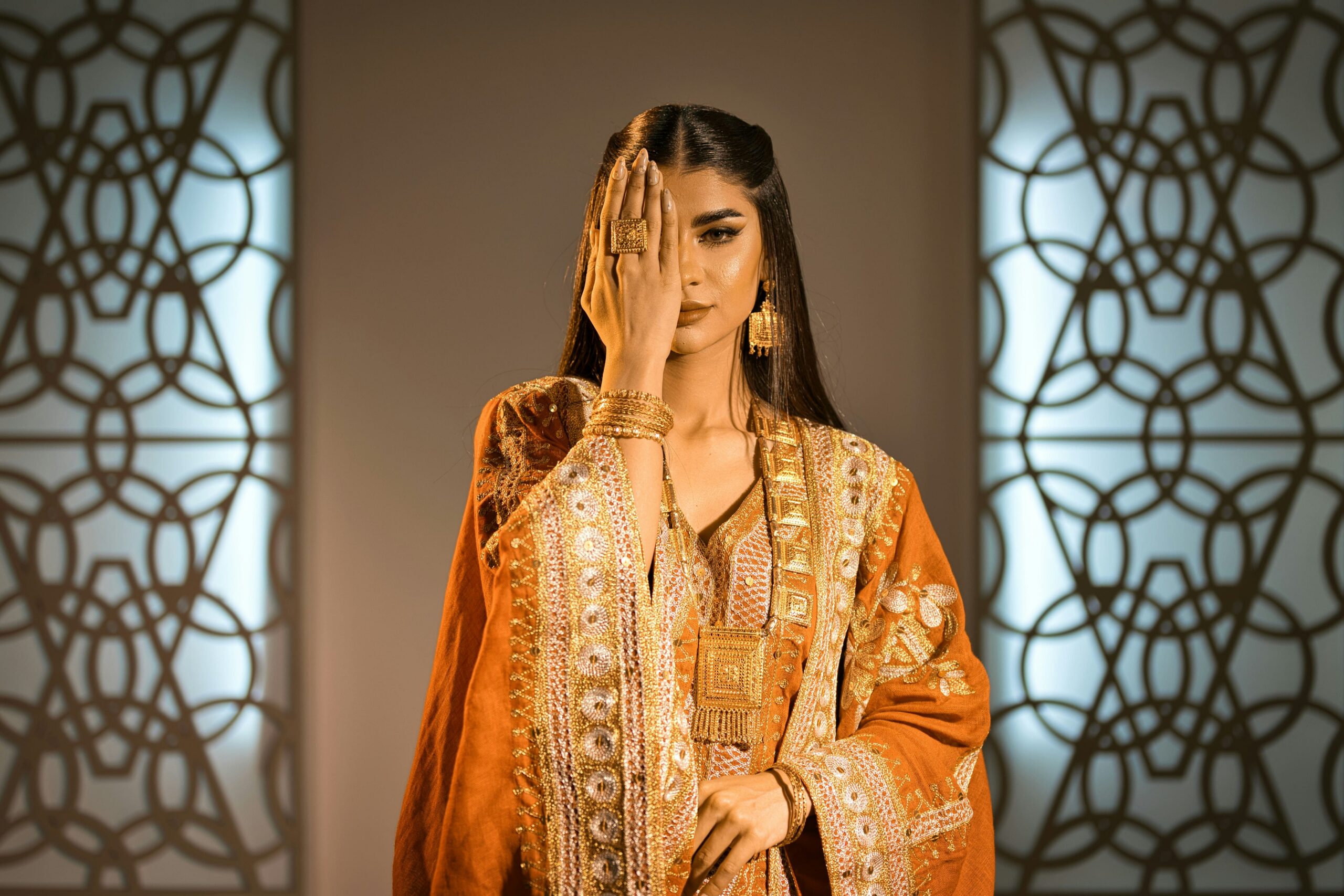
For nearly a century, the high-luxury landscape of the Gulf Cooperation Council and the wider Levant was defined by a highly profitable, yet asymmetric, relationship with Europe. The historic salons of Paris’s Place Vendôme and London’s Bond Street viewed the Middle East primarily as an ultra-lucrative, passive consumer demographic. It was considered in the recent past as a market to be courted with sweeping romanticized narratives of the “Orient” and standardized collections of diamonds and platinum.
Today, however, a profound paradigm shift is underway. A vibrant, highly sophisticated cohort of homegrown independent jewelers from Beirut, Jeddah, Dubai, and Amman is dismantling this velvet hegemony. By reclaiming their own cultural archives, ranging from pre-Islamic archaeological motifs and Bedouin symbolism to avant-garde Arabic typography, these designers are asserting a new form of creative sovereignty. They are no longer merely consumers of luxury; they are its authors.
To understand the rise of these designers, one must first analyze the semiotic shift in their design language. For decades, Western luxury conglomerates considered the Middle East through generic design codes relying on repetitive mosaic patterns or literal interpretations of “Thousand and One Nights” folklore. Designers originating from Arabic countries are systematically decolonizing this aesthetic, replacing external fantasies with authentic, deeply lived regional narratives.
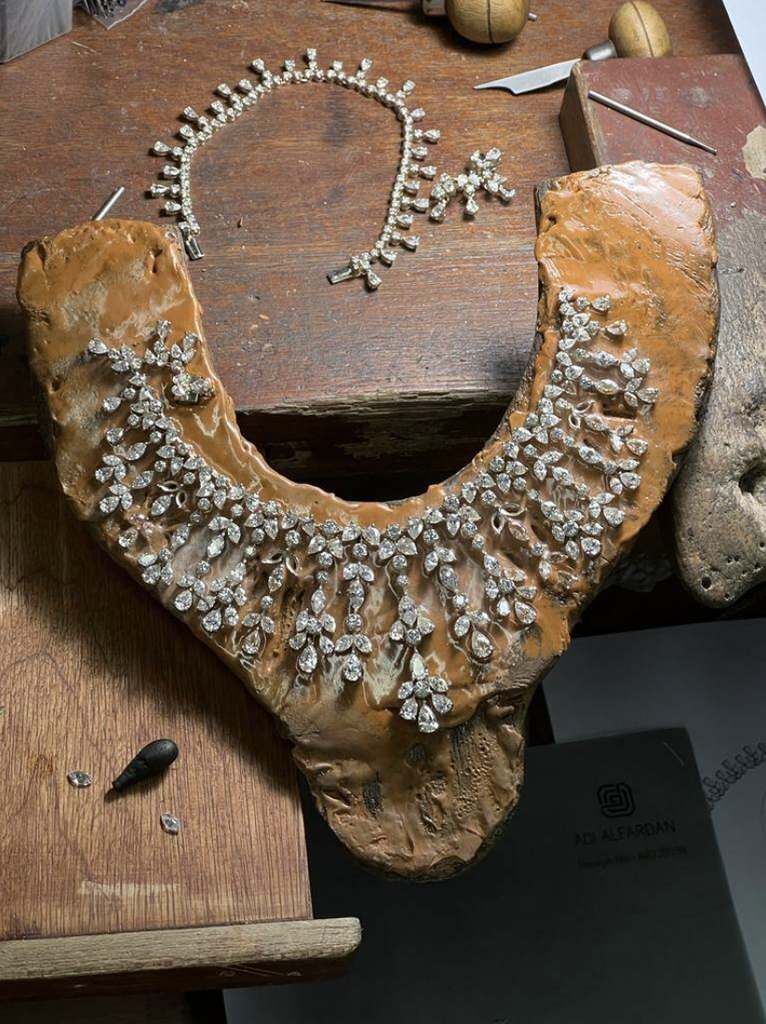
Necklace with diamonds at the Adi Alfardan Jewelry studio, 2023. Photo by: Adi Alfardan Jewelry (https://likeabeautifuljewel.com/en/jewellery/adi-al-fardan-the-passion-for-jewellery-in-heritage)
This is not superficial folklore; it is a highly intellectualized design lexicon. Arabic calligraphy, for example, is stripped of its purely calligraphic or religious traditionalism. Instead, it is treated as a structural, modernist architectural element. Letters are deconstructed into minimalist geometric lines, transforming words of poetry or protection into abstract wearable sculptures.
Consider Adi Alfardan, the Dubai-based high jewelry house that exemplifies this new era of sovereign luxury. Alfardan does not merely design jewelry; he curates legacy. By sourcing the world’s rarest natural pearls and mounting them in contemporary settings of colored diamonds, Alfardan bypasses the standardized vocabulary of European high jewelry. His pieces offer regional collectors something Place Vendôme cannot: an authentic, localized lineage fused with unparalleled bespoke craft.
Similarly, Beirut’s L’Atelier Nawbar uses jewelry as a medium for narrative storytelling. Founded by sisters Dima and Tania Nawbar, the brand represents a multi-generational Lebanese heritage that translates Levantine mysticism, cosmic talismans, and regional resilience into vibrant, hand-painted enamel and hand-carved gemstones. In Dubai, Gafla reimagines traditional Bedouin symbols, such as the Merwed (the classic stick used to apply kohl), transforming them into sleek, diamond-encrusted contemporary pendants that speak directly to a shared regional memory.
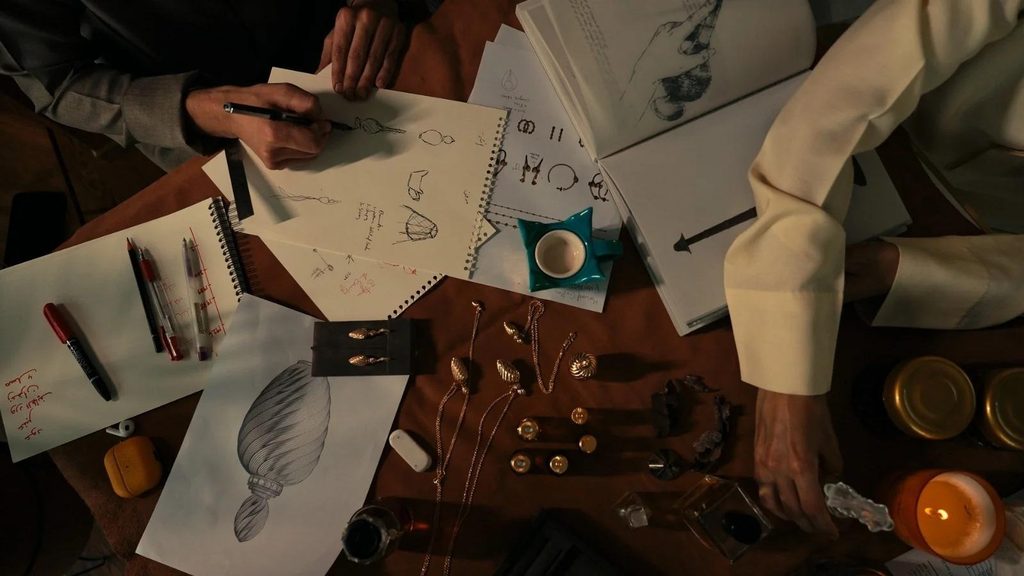
Gafla’s redesigning process for Merwed collection, 2024. Photo by: Gafla Jewellery (https://gaflajewellery.com/en-fr/blogs/news/merwad-collection?srsltid=AfmBOorV78al9SadkO6cmx6TuaXuvDK7L1RaKlLZ_NTZT9gmx42bfKiW)
All these local designers and Maisons and using a powerful Indo-Arabian axis reimagining the Historic Trade Winds.
A critical, often overlooked dimension of this creative renaissance is the strategic revival of the Indo-Arabian Axis. The relationship between India, the historic jewel in the crown of global lapidary arts, and the Middle East is not new; it is a centuries-old maritime romance. Historically, Gulf merchants traded prized natural pearls for Indian diamonds, rubies, and emeralds; a trading which was at its climax during the Mughal Empire.
Today’s Middle Eastern designers are actively using this historic trade corridor to bypass the rigid, Euro-centric supply chains of Switzerland and France. Rather than relying on Parisian ateliers, regional designers are collaborating directly with master artisans in Jaipur and Mumbai.
This is a masterstroke of provenance arbitrage. By marrying Middle Eastern creative direction with India’s unparalleled expertise in specialized techniques, local designers are creating a hybrid aesthetic that is deeply rooted on both sides. Jaipur’s lapidary ateliers allow Middle Eastern designers to source and custom-cut colored gemstones with an organic quality; one quality contrasting sharply with the clinical, machine-perfect cuts favored by Western corporate luxury brands. This Indo-Arabian synergy allows for a more agile, expressive, and culturally resonant form of High Jewelry. The Middle East becomes slowly but surely an autonomous incubator for new high jewellery.
This creative awakening is not happening in a vacuum; it is supported by a robust, state-level institutional infrastructure. Across the GCC, governments have recognized that luxury and creative industries are vital pillars of post-oil economic diversification and cultural diplomacy.
In Saudi Arabia, the Saudi Fashion Commission, particularly through its groundbreaking 100 Brands initiative, provides rigorous mentorship, financial advisory, and global showcase opportunities to emerging jewelers. Similarly, the Dubai Design District also known as d3 has created a physical and regulatory ecosystem where local designers can co-exist, collaborate, and access international markets.
Crucially, the financial architecture of the region has shifted. Local venture capital firms and prominent family offices are increasingly redirecting their investment portfolios away from minority stakes in European luxury conglomerates toward direct equity investments in local creative talents. This infusion of smart capital allows independent brands to scale their supply chains, invest in secure inventory, and establish high-profile retail footprints.
Simultaneously, the traditional historic department stores of Europe have been effectively bypassed. The hyper-digitization of the Middle Eastern market, led by luxury e-commerce behemoths like Ounass and bespoke personal shopping networks like Thread Styling, has democratized access to the consumer. Local designers no longer need the validation of a Paris Maison to reach their audience; they have direct, intimate, and immediate access to the world’s most active luxury consumers through digital platforms.
This strong strategic positioning allows luxury analysts to examine the difference between “Intimate Luxury” vs. “Institutional Legacy”.
Analyzing the competitive landscape requires understanding a fundamental shift in the psychology of the modern Middle Eastern collector. The contemporary GCC consumer is among the most sophisticated in the world. They are globally educated, highly traveled, and already possess the iconic, widely available collections of the major French and Italian houses.
Consequently, the allure of “Institutional Legacy”, the safe, predictable luxury of wearing the same diamond bracelet as thousands of others, is waning. It is being replaced by a desire for “Intimate Luxury”, pieces that carry emotional resonance, intellectual depth, and cultural specificity.
GCC designers do not seek to compete with European Maisons on sheer volume or marketing spend. Instead, they win on cultural intimacy. A piece of jewelry from a local designer is a conversation starter, a statement of identity, and a declaration of pride in the region’s booming creative renaissance.
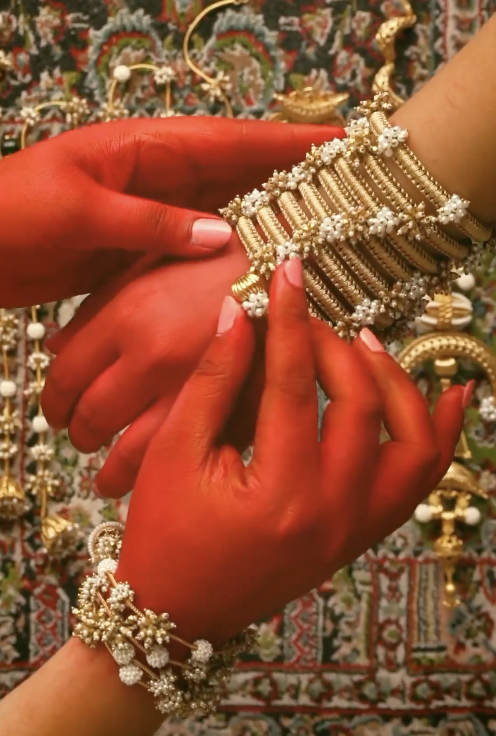
Jewelry from the BASRAA Collection by Amama, 2024. Photo by Umang Kapoor (https://www.cosmos.so/e/562517543)
This situation is so unique that we can question the possible risks and, first, the natural regional ceiling these brands can reach.
The most pressing strategic question facing GCC designers is scalability beyond their domestic market. The cultural intimacy that gives these brands their competitive edge , Bedouin symbolism, Emirati pearl-diving heritage, Levantine talismanic motifs , is also, paradoxically, what limits their legibility to non-regional consumers despite the fact that Middle East has inspired as well European Maisons in the past.
A collector in Riyadh intuitively understands the emotional weight of a Merwed-inspired pendant. A client in Shanghai or São Paulo does not. European maisons solved this problem decades ago by building universal mythologies (Cartier’s panther, Van Cleef’s Alhambra clover) , symbols deliberately emptied of specific cultural content to travel globally without friction. Middle Eastern brands have yet to develop a strategic framework for translating cultural specificity into global desirability without diluting the very authenticity that defines them. Until they do, the risk of remaining high-end regional brands even if they are respected is real.
The Indo-Arabian supply chain is a genuine strategic advantage, but it carries significant operational vulnerabilities. The master artisans in Jaipur and Mumbai upon whom many of these brands depend on, represent an aging labor pool. Skilled Kundan setters and Meenakari enamelers, whose artistry is irreplaceable, are retiring faster than new artisans can take their place. A young entrepreneur who builds their entire value proposition on hand-carved Indian gemstones and artisanal techniques must confront a hard question: what happens when the hands disappear?
Furthermore, quality control across geographically fragmented ateliers is inherently difficult. Where a single flawed setting can destroy a piece worth tens of thousands of dollars, maintaining the consistency required for high jewelry demands physical presence, deep relationships, and rigorous protocols that take years to build.
It would be analytically naive to treat European luxury houses as passive incumbents. They are not. Cartier, Van Cleef, Bvlgari, and Chanel Haute Joaillerie have significantly increased their Middle Eastern cultural programming from region-specific high jewelry collections to local atelier partnerships and Arabic-language brand storytelling. They possess vastly superior marketing budgets, global distribution networks, and decades of accumulated brand equity. The competitive moat of homegrown designers is real but narrow. It must be continuously deepened through innovation, not merely defended through rhetoric.
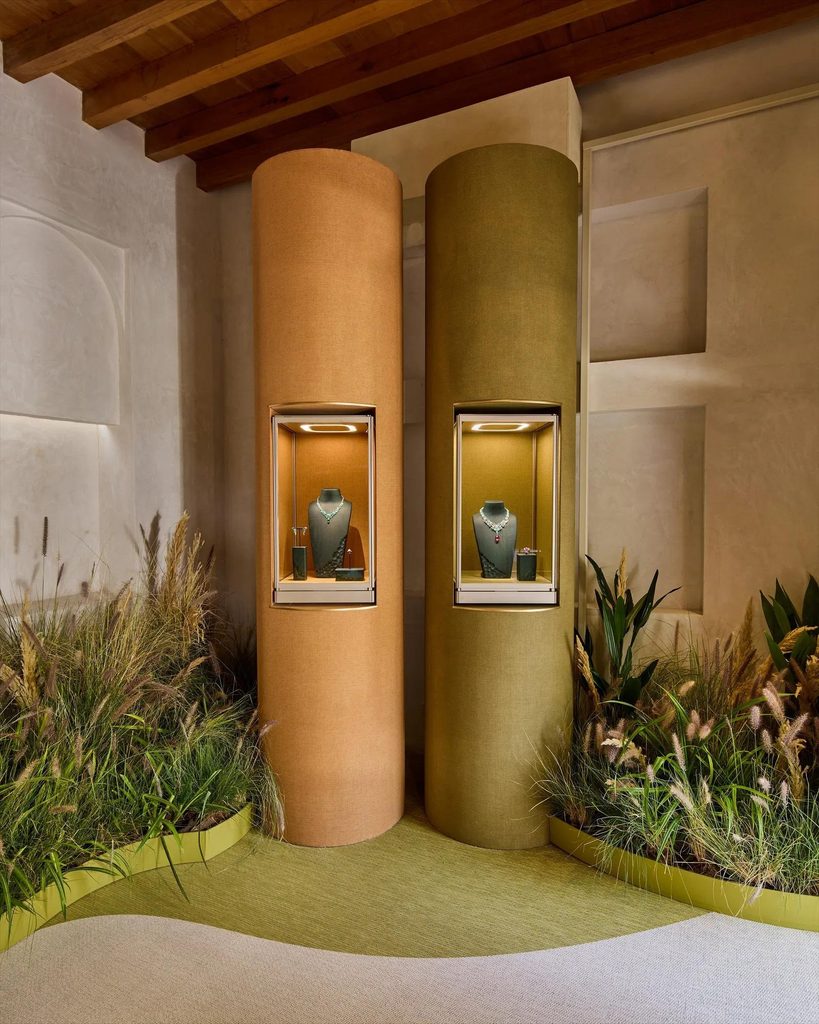
Still from the Journey of Wonders showcase by Cartier in Dubai, 2025. Photo by: Cartier (https://www.voguearabia.com/article/cartier-a-journey-of-wonders-exhibition-al-shindagha-museum)
As “heritage-driven design” becomes commercially validated, the temptation to treat culture as a marketing input rather than a lived practice grows. Superficial deployment of calligraphic motifs or archaeological references without natural genuine scholarly depth or community engagement risks producing a form of self-exoticism that is ultimately as hollow as the Orientalist tropes it claims to replace. Expert consumers will detect this inauthenticity quickly. Doing this will have a severe impact on brand reputation accused of cultural over usage for commercial purposes in a region where cultural pride and symbolism is one of the strongest in the world. As for European brands, the usage of local culture must be cleverly done with details more than a full yearly work and collections inspired by local culture as the one and only inspiration.
The rise of independent jewelry designers across Beirut, Jeddah, Dubai, and Amman is far more than a fleeting trend; it is a structural realignment of the global luxury economy. By leveraging their rich historical archives, reclaiming the ancient Indo-Arabian trade routes for artisanal production, and utilizing state-backed infrastructure, these designers have successfully built globally competitive brands.
As they continue to capture the hearts and portfolios of the region’s elite, these “Desert Diamonds” are proving that the future of luxury lies not in the homogenization of global brands, but in the fierce, uncompromising celebration of localized, sovereign heritage. The new Silk Road of Haute Joaillerie has been paved, and this time, the creative direction is coming entirely from within.
Leave a Reply