How Consumers Use Luxury As An Identity Verifier
As humans, we place significant value on two of the most basic aspects of social life: our identity and our desire to associate with others. Across generations, self-recognition and social connections have influenced an individual’s quality of life, both directly and indirectly. In a contemporary society, where personal expression and memorable experiences are increasingly favoured, the desire for community and belonging has become more pronounced than ever.
Identity is often communicated through an intentionally curated combination of values, culture, knowledge, and personal preferences. An individual’s self-perception influences how they present themselves and the people they value as connections. One of the most powerful languages through which one can communicate their sense of self and societal positioning is luxury. With that said, how exactly does one translate luxury into identity?

A photograph from Tempus Jewellery featuring a diamond ring and tennis bracelet. https://www.cosmos.so/e/1689622486
Luxury As Identity
When luxury is expressed as a primary form of self-expression, it signals a distinct standard of expectation, from both oneself and society. More often than not, luxury signifies a sophisticated lifestyle, embraced by those who value a highly selective and personalized way of life. However, it is not mere access that validates an individual’s position within luxury, but rather the manner in which they engage with luxury itself.
This reframes luxury as less about possession and more about articulation as an external expression of internal identity. It allows an individual to translate abstract elements of the self – taste, aspiration, values, and personal recognition – as visible and socially legible forms of expression, making identity both observable and socially interpretable.
Identity in Luxury
Luxury was initially associated with hedonistic consumers who had positioned luxury as a signifier of their immense wealth and social standing. Their indulgences in luxury were perceived as investments that sustained their status and lifestyle. At the time, opulence was what defined their identities and influenced their social ties. An individual’s self-expression was centred around extravagant adornments and statement pieces that were designed to mirror their wealth. However, the perception of luxury has since expanded. In the contemporary context, luxury has increasingly become centred on emotional values and social representations that now reflect an individual’s identity and associations. Every interaction with luxury is refined to represent who an individual is and what they embody. Importantly, luxury operates on both self-directed and externally projected identity. It is how an individual can simultaneously construct their own sense of self, and how that self is interpreted, validated, or repositioned within the perception of others.
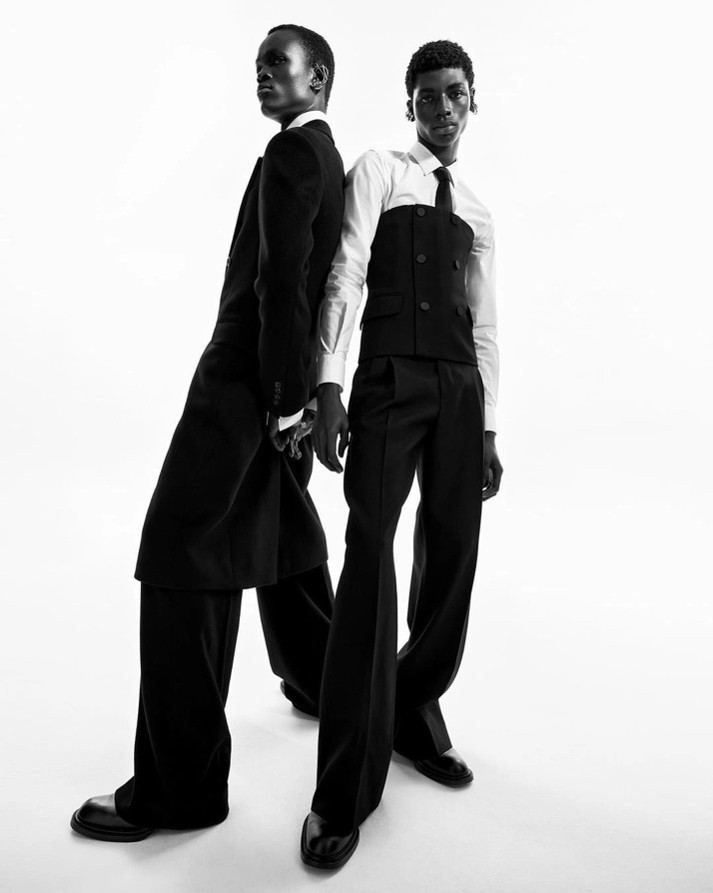
Photo by Kosmas Pavlos for The Glass Magazine (https://www.cosmos.so/e/996799830)
Identification with Luxury
The foundational concept of luxury is intentionality. It is the consideration behind each aspect, from the pre- to post- experience, that makes luxury truly luxurious. In a day and age where self-expression is loud but emotional resonance is louder, individuals often engage with experiences that reflect their voices or embody their values. Therefore, the potential of any interaction by an individual is measured against a personal value scale, with a primary focus on “What will this make me feel?” and “Who can I share it with?”.
An individual whose identity and social connections are built upon luxury fashion would not continuously engage with every available fashion house, but rather reserve their loyalty for the brands that best reflect and respect their identity. Luxury is therefore experienced through carefully selected fashion houses that publicly uphold a similar ethos. For instance, choosing to stand with a fashion house such as Dior is also a choice to align with the values of its savoir-faire. From quality and craftsmanship to sustainability and cultural positioning, each aspect identifies with both the individual and the fashion house. Here, an individual does not engage with the brand solely as a client but as a contributor in a broader narrative. This places both the individual and the house on each other’s radar of shared identities, which over time builds connections, recognition, and affiliation. This level of intentionality creates a reciprocal sense of identity among the individual, the brand, and the broader society they seek recognition within.
Luxury, the ID
At its core, luxury operates as a mechanism through which identity is not only expressed but also reinforced through recognition. It has become a space where self-expression and social belonging come together, allowing individuals to situate themselves within a collective of shared values and perspectives. In this sense, luxury extends beyond tangible possessions and acts as a social language that continuously authorizes recognition between the individual and society. Luxury has now become a salient system of identification to recognise how an individual perceives themselves, how they want to be perceived, and the communities they identify with. Through the dynamic relationship between identity and recognition, luxury has become a central framework of self-definition, one that validates belonging while simultaneously distinguishing individuality within a shared cultural space.
Leave a Reply