How New-Age Luxury Enterprises Construct Legitimacy
If we open any classic study on luxury architecture, it becomes immediately clear that heritage is the foundational element of a brand’s DNA. It is the historical background that creates the myth, constructs the brand legend, and separates true luxury from the premium segment. Heritage serves as a social validator, proving that a house has withstood the test of time and earned its status among the cultural elite.
For a young venture, this traditional requirement feels like an immediate dead end. When a brand is only a few years old, it simply lacks the chronological proof to support its positioning. At the same time, any attempt to mimic the aesthetics of a century-old house feels fabricated, failing to build any real emotional connection with the audience.
Consequently, the Archive Gap is not merely the absence of historical material; it is a structural rift in social legitimacy.
Yet legitimacy itself is not inherently bound to inherited time. While traditional luxury accumulated authority through chronology, emerging brands construct it through alternative forms of cultural capital. Broadly speaking, three mechanisms emerge: borrowing authority from place, manufacturing future heritage through product design, and building symbolic density around the founder’s personal mythology.
This means emerging brands cannot follow the old playbook. They have to build depth in real time, turning the lack of a past into an aggressive strategy. In this article, we will break down exactly how to construct that legitimacy from day one.
The Archive Gap: Why Mimicking History Fails
In The Luxury Strategy, Jean-Noël Kapferer establishes a fundamental law of the industry: time is the ultimate barrier to entry in the luxury market. Heritage houses leverage their longevity as a decisive competitive advantage, given that time is the only resource that cannot be bought or scaled through capital injection.
Kapferer notes that for an emerging brand, attempting to compete on the battlefield of tradition and mimic legacy luxury is a guaranteed losing strategy. Instead of trying to replicate the trajectory of century-old giants, new players must create fresh cultural codes and meanings here and now. Playing by the old rules only highlights a newcomer’s inability to recognize and respond to the shifts shaping the modern luxury market, whereas a young brand’s true strength lies in its ability to reflect the contemporary context.
This idea aligns perfectly with the sociological research of Marie Sicard, who breaks down the structure of the luxury myth. Sicard emphasizes that luxury functions as a system of signs and a social validator: consumers do not acquire an item for its utility, but to strengthen their status within the cultural elite.
However, this myth only functions when society recognizes it as authentic. When a young brand attempts to artificially construct a narrative around a non-existent heritage, the semiotic system collapses. A luxury consumer immediately detects the misalignment between the claimed history and the actual background. It is precisely this disconnection that creates the Archive Gap – the gap between the authority a brand attempts to project and the legitimacy it can genuinely claim. As a result, cultural legitimacy is lost before market position is even established.
Consequently, the Archive Gap is not merely the absence of historical material; it is a structural rift in social legitimacy.
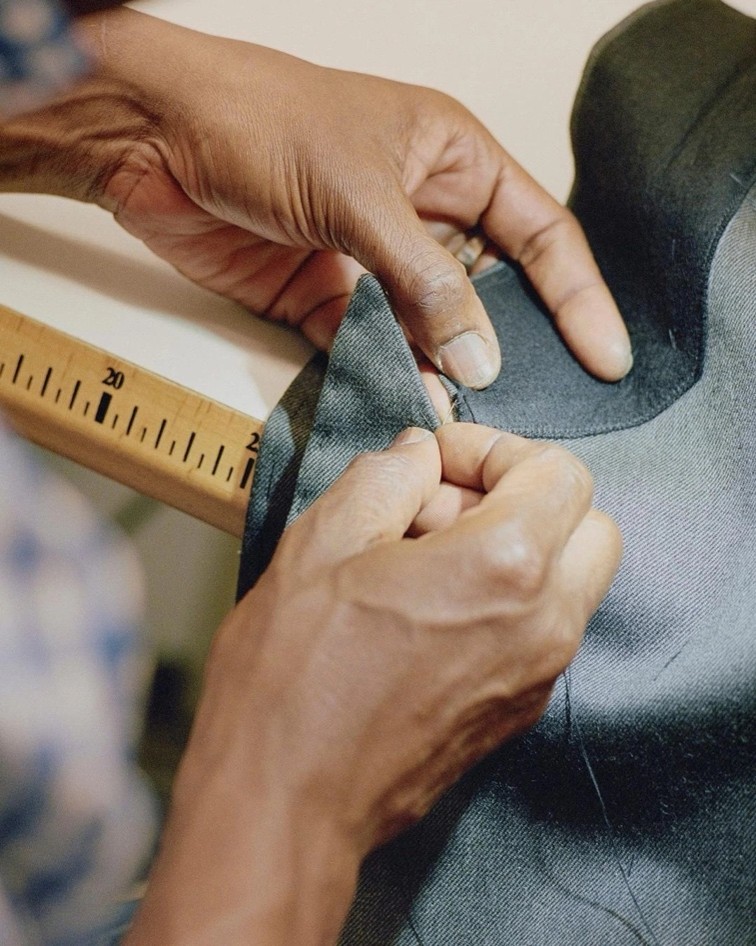
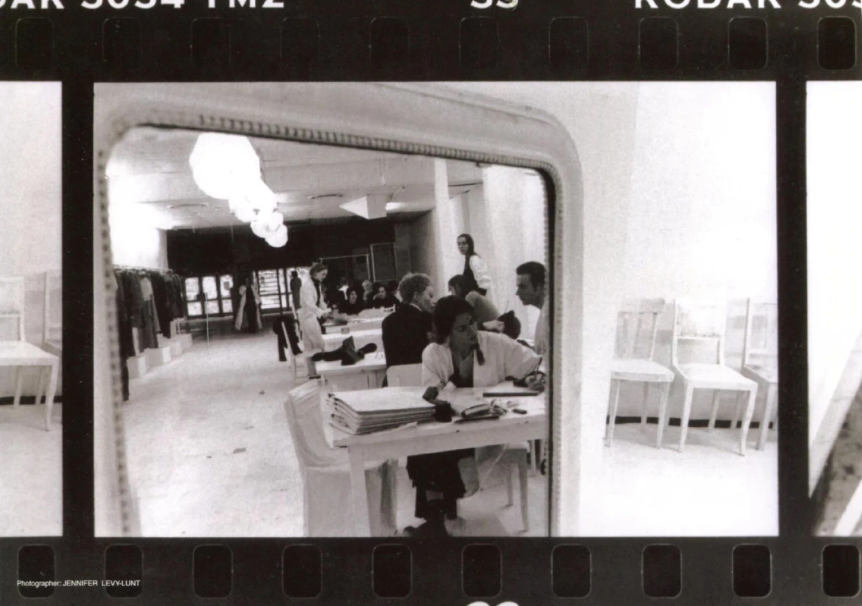
A look inside the A.P.C. atelier at 39 Rue Madame in Paris, where collection prototypes are made. https://www.cosmos.so/e/1897621208
Borrowed Ancestry: Heritage As an Ecosystem
When a brand has no yesterday, attempts to imitate historic depth often feel artificial. The new luxury paradigm solves this by shifting authority away from corporate chronology and toward the geography of production itself. If you have no past, your strongest asset becomes where and by whom you are created today.
Rather than inventing fictional legends or designing imaginary family crests, emerging luxury brands engage in spatial anchoring. This is the process by which authority accumulated over centuries within a specific geographic territory is transferred to objects produced within its boundaries.
Case study: Métier London
Founded in 2017, Métier London did not attempt to fabricate artificial London-centric heritage. Instead, the brand anchored its production in Italy, partnering with artisanal workshops in Florence.
Founder Melissa Morris spent years working alongside manufacturers specializing in complex custom leatherwork, structural construction techniques, and generational craftsmanship. Rather than relying on its own historical narrative, the brand leverages the accumulated authority of Italian artisan ecosystems.
This creates a fundamental shift in luxury semiotics. Even without fictional heritage, the product is embedded with real, verifiable craft traditions. Consumers recognize this authenticity because craftsmanship is materially legible in the object itself.
In this model, the brand performs a legitimate borrowing of territorial memory—transferring cultural and historical capital from place to product. Someone else’s lineage becomes embedded in its own identity.
The implication is clear: craftsmanship is the closest functional equivalent to time. By anchoring authority in place, emerging brands bypass the temporal barrier of luxury and gain immediate cultural credibility.
Yet geography is only one layer of substitution.
The Future Vintage
Some brands take a more radical approach: instead of borrowing history, they manufacture it in advance.
Here, the present moment is treated as an archive forming in real time. The product is designed not for seasonal relevance, but for future historical value.
This transformation is achieved through two mechanisms:
Raw Numbering
Edition marking turns the product into a collectible archive. Brands such as RSVP Paris emboss unique serial numbers on each piece (e.g., 012/500), while Maison Margiela uses systematic numerical coding as part of its identity language.
These markers position the object immediately within a finite historical series.
Limited Drops
Strict production limits ensure that items disappear permanently from circulation after release. Brands like Phoebe Philo use fixed editions that are never restocked, forcing products into scarcity-driven archival status.
Together, these mechanisms eliminate the need for brand history. The customer is no longer buying a seasonal item—they are acquiring a future artifact of fashion history as it is being written in real time.
Yet products alone are not enough. Luxury also depends on narrative.

Jewelry and accessories from the Jacquemus La Galerie collection. Photo by Yoann et Marco https://www.cosmos.so/e/719826189
Personal Myth-Making: The Founder Fs a Legitimacy Source
If traditional luxury houses built authority through institutional memory, contemporary brands increasingly build it through personal mythology.
The locus of legitimacy shifts from company history to founder biography. Instead of inheriting a legend, the founder becomes the legend.
Case study: Jacquemus
Jacquemus demonstrates this mechanism with clarity. Rather than competing with the historical weight of Parisian maisons, Simon Porte Jacquemus constructed a personal narrative universe rooted in Provence, maternal figures, Mediterranean landscapes, and emotional intimacy.
These elements function not as marketing decoration, but as a coherent symbolic system. Consumers are not only purchasing products; they are entering a lived mythology with consistent emotional and cultural references.
This works because personal experience carries an authenticity that cannot be manufactured at scale. A biography cannot be faked retroactively, nor easily replicated by competitors. Over time, the repeated use of these personal narratives across collections, campaigns, runway shows, and public appearances transforms lived experience into symbolic capital.
Thus, personal mythology becomes a substitute for institutional heritage.
Conclusion: The Architecture of Instant Equity
The central mistake of emerging founders is assuming that luxury is a destination reached only through time. This mindset forces imitation rather than innovation.
In reality, luxury is not a function of time – it is a function of density; density of meaning, craft, and intent.
Modern luxury brands build trust and reputation by borrowing authority from place through craftsmanship and geography, embedding historical value into products designed as future collectibles, and transforming the founder’s personal mythology into a source of symbolic capital. Together, these mechanisms form what can be called Instant Equity: a system where legitimacy is not inherited but deliberately engineered from day one.
The implication is simple: luxury is a system of signs that society agrees to value. If those signs are embedded with enough precision, depth, and cultural intelligence, the market stops asking how old a brand is and starts asking what it represents.